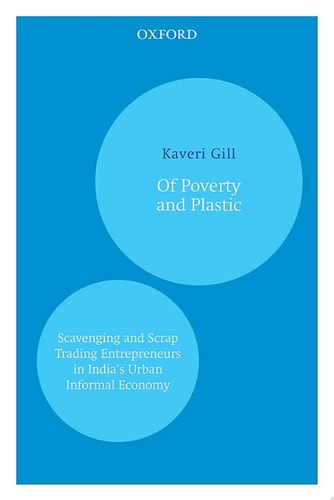
Of Poverty and Plastic: Scavenging and Scrap Trading Entrepreneurs in India’s Urban Informal Economy
0
0
As an Amazon Associate and affiliate partner, Menrva Books earns from qualifying purchases. Learn more
Author Description
Of Poverty And Plastic Applies An Interdisciplinary, 'field Economics' Approach To Poverty Analysis, Using A Mix Of Survey And Ethnographic Data To Challenge Received Notions Of The Nature And Extent Of Narrow Income Poverty And Multiple Deprivations Experienced By Those Working In The Informal Waste Recovery And Plastic Recycling Economy Of Delhi. A Detailed Analysis Of Specialization, Capital, And Value In Various Segments Of This Labour-intensive, 'green' Informal Market Is Undertaken, With Explicit Recognition Of Its Wider Social And Political Institutional Context, And How It Is Shaped By Unequal Interactions With Civil Society And The State. In Particular, The Book Focuses On The Identity And Agency Of Subordinate Scheduled Caste Groups—living Literally And Metaphorically On The Edge Of The City—in Negotiating 'a Decent Life' In Today's Neoliberal Environment. The Case Studies Of The Ban On Recycled Polythene Bags And The Industrial Relocation Order Illustrate The Channels Through Which These Actors Collectively Seek To Resist The Perceived Anti-urban Poor Status Quo, Driven By Powerful Middle Class Coalitions Through Legislation Or Judicial Fiat, With Varying Degrees Of Success. In Doing So, The Book Exposes The Complex, And At Times Contrary, Policy Reality Binding Poverty And Deprivation, Formal And Informal Markets, The State And Citizenship In Contemporary Urban India.
Menrva's Summary
THE THESIS
This work investigates the complex intersection of poverty, informal labor markets, and state policy within the waste recovery and plastic recycling sectors of Delhi. Author Kaveri Gill utilizes an interdisciplinary 'field economics' framework, synthesizing survey data with ethnographic research to challenge conventional metrics of income poverty. By examining the agency of marginalized Scheduled Caste groups, the book argues that these populations actively negotiate their livelihoods against a backdrop of neoliberal urban expansion and exclusionary state interventions.
THE SCOPE MAP
What You Will Find
- Analysis of labor-intensive informal markets and the economics of plastic recycling.
- Case studies on the impact of legislative bans on recycled polythene and industrial relocation orders.
- Ethnographic data detailing the social and political institutional context of Delhi's waste pickers.
- Examination of the power dynamics between subordinate labor groups and middle-class urban coalitions.
THE AUTHORITY PERSPECTIVE
Experts recognize this text as a significant contribution to development studies for its granular approach to the informal economy. Scholars frequently highlight the book's success in bridging the gap between quantitative economic analysis and qualitative sociological observation.
Page Count:
352
Publication Date:
2009-01-01
Publisher:
OUP India
ISBN-10:
0199088098
ISBN-13:
9780199088096
Economics
Politics
Poverty
Kindle eBooks
Words Language & Grammar
India
Categories
Urban Studies
Kindle Store
Reference
Sociology
Consumer Behavior
Unemployment
Linguistics