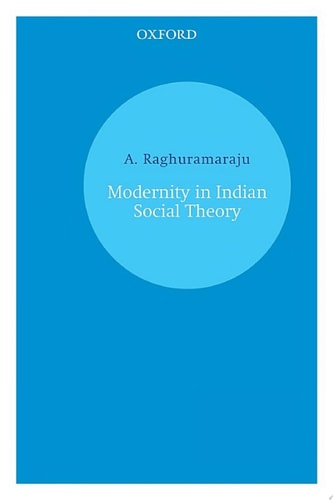
Modernity in Indian Social Theory
0
0
As an Amazon Associate and affiliate partner, Menrva Books earns from qualifying purchases. Learn more
Author Description
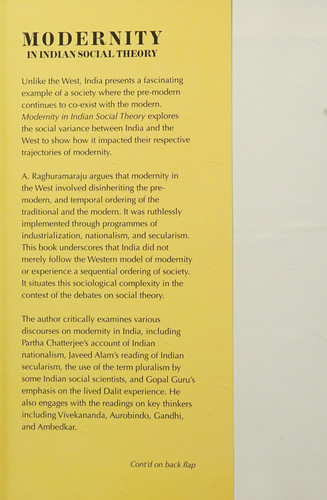
This volume revisits the question and concept of modernity in Indian social theory and how this reading could be used to understand contemporary Indian society and texts. It discusses the limitations surrounding Indian social theorists' discussion of Indian society. The book focuses on specific seminal accounts like that of Partha Chatterjee on Indian nationalism, Javeed Alam on the reading of Indian secularism, and Gopal Guru on the Dalit lived experience. Subsequent chapters critically examine the writings of key thinkers including Vivekananda, Aurobindo, Gandhi, and Ambedkar.
Menrva's Summary
THE THESIS
This volume investigates how the concept of modernity is constructed and contested within Indian social theory to better interpret contemporary societal structures. A. Raghuramaraju, a scholar of Indian philosophy and social thought, evaluates the limitations of existing theoretical frameworks by analyzing the works of prominent Indian intellectuals. The text provides a critical assessment of how these thinkers have navigated the intersection of Western modernity and indigenous social realities.
THE SCOPE MAP
What You Will Find
- Critical analysis of Indian nationalism as framed by Partha Chatterjee
- Examination of secularism through the lens of Javeed Alam
- Exploration of Dalit lived experience as articulated by Gopal Guru
- Comparative studies of the intellectual contributions of Vivekananda, Aurobindo, Gandhi, and Ambedkar
THE AUTHORITY PERSPECTIVE
Scholars in the field of South Asian studies recognize this work as a significant contribution to the ongoing debate regarding the decolonization of social theory. Readers frequently note the academic density of the prose, which is intended for advanced students and researchers of political philosophy.
Page Count:
188
Publication Date:
2010-01-01
Publisher:
OUP India
ISBN-10:
0199088365
ISBN-13:
9780199088362
Philosophy
History
Politics
Indian Studies
Categories
Sociology india
Sociology
Eastern
India
Social Theory
Kindle Store
Kindle eBooks
Asia