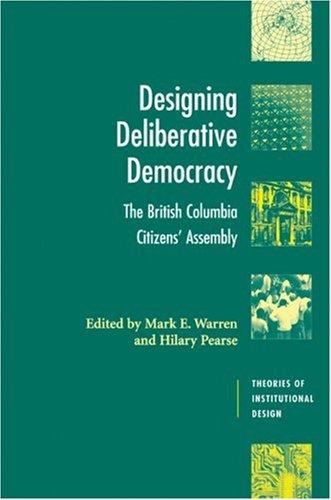
Designing Deliberative Democracy
0
0
As an Amazon Associate and affiliate partner, Menrva Books earns from qualifying purchases. Learn more
Author Description
Is it possible to advance democracy by empowering ordinary citizens to make key decisions about the design of political institutions and policies? In 2004, the government of British Columbia embarked on a bold democratic experiment: it created an assembly of 160 near-randomly selected citizens to assess and redesign the province's electoral system. The British Columbia Citizens' Assembly represents the first time a citizen body has had the power to reform fundamental political institutions. It was an innovative gamble that has been replicated elsewhere in Canada and in the Netherlands, and is gaining increasing attention in Europe as a democratic alternative for constitution-making and constitutional reform. In the USA, advocates view citizens' assemblies as a means for reforming referendum processes. This book investigates the citizens' assembly in British Columbia to test and refine key propositions of democratic theory and practice.--Jacket.
Menrva's Summary
THE THESIS
This book investigates the feasibility of advancing democracy through citizen empowerment in the design of political institutions and policies. It examines the 2004 British Columbia Citizens' Assembly, a groundbreaking experiment where 160 randomly selected citizens were tasked with redesigning the province's electoral system. The book analyzes this assembly as a model for democratic reform, exploring its replication in other regions and its potential application in constitutional reform and referendum processes. The core of the work tests and refines propositions of democratic theory and practice through this specific case study.
THE SCOPE MAP
- Analysis of the British Columbia Citizens' Assembly as a model for democratic reform.
- Examination of the first instance of a citizen body empowered to reform fundamental political institutions.
- Case study of an innovative gamble replicated in Canada and the Netherlands.
- Discussion of citizens' assemblies as a democratic alternative for constitution-making and constitutional reform.
- Exploration of the potential for citizens' assemblies in reforming referendum processes, particularly in the USA.
- Theoretical propositions of democratic theory and practice tested against real-world application.
THE AUTHORITY PERSPECTIVE
The book examines the British Columbia Citizens' Assembly as a significant democratic experiment, highlighting its innovative approach to citizen empowerment in institutional reform. It positions the assembly as a potential model for democratic alternatives in constitution-making and policy design, noting its replication and growing international attention. The work is framed as a test of democratic theory against practical application, offering insights into the efficacy of deliberative processes involving randomly selected citizens. The analysis suggests that such assemblies are gaining traction as a means to enhance democratic participation and reform political systems.
Page Count:
256
Publication Date:
2008-01-01
ISBN-10:
0521885078
ISBN-13:
9780521885072
History
Politics
Non-Fiction
Democracy
Public Policy
Case Study
Community Tags
Similar Books