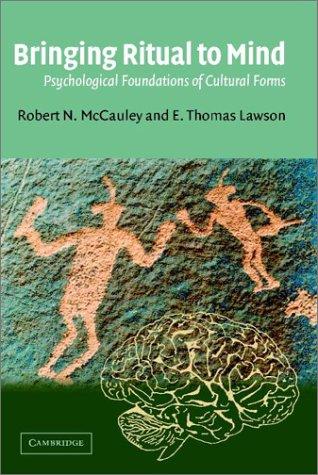
Bringing Ritual to Mind
0
0
As an Amazon Associate and affiliate partner, Menrva Books earns from qualifying purchases. Learn more
Author Description
Bringing Ritual to Mind explores the cognitive and psychological foundations of religious ritual systems. Participants must recall their rituals well enough to ensure a sense of continuity across performances, and those rituals must motivate them to transmit and re-perform them. Most religious rituals the world over exploit either high performance frequency or extraordinary emotional stimulation (but not both) to enhance their recollection; the availability of literacy has little impact on this. But why do some rituals exploit the first of these variables while others exploit the second? McCauley and Lawson advance the ritual form hypothesis, arguing that participants' cognitive representations of ritual form explain why. Reviewing evidence from cognitive, developmental and social psychology, cultural anthropology, and the history of religions, they utilize dynamical systems tools to explain the recurrent evolutionary trajectories religions exhibit.
Menrva's Summary
THE THESIS
This book investigates the cognitive and psychological underpinnings of religious ritual systems. It explores how participants' memory of rituals ensures continuity and motivates their transmission, examining the common strategies of high frequency or emotional stimulation. The authors introduce the ritual form hypothesis, positing that cognitive representations of ritual form dictate the choice between these strategies. The work draws on evidence from multiple disciplines to explain the evolutionary patterns observed in religions.
THE SCOPE MAP
- Cognitive and psychological foundations of religious ritual systems
- The ritual form hypothesis explaining ritual strategy choices
- Evidence from cognitive psychology, developmental psychology, social psychology, cultural anthropology, and the history of religions
- Application of dynamical systems tools to explain religious evolutionary trajectories
THE AUTHORITY PERSPECTIVE
The book is recognized for its interdisciplinary approach, synthesizing findings from psychology, anthropology, and religious history to explain the persistence and evolution of religious rituals. It advances the ritual form hypothesis as a key explanatory framework for understanding why certain rituals rely on frequency and others on emotional intensity. The work is noted for its use of dynamical systems tools to model religious trajectories. The analysis is grounded in empirical evidence and theoretical models, offering a robust framework for understanding ritual cognition.
Page Count:
250
Publication Date:
2002-01-01
ISBN-10:
0521016290
ISBN-13:
9780521016292
Non-Fiction
Religion
Psychology
Cognitive Psychology
Psychology of Religion
Cultural Anthropology
Community Tags
Similar Books