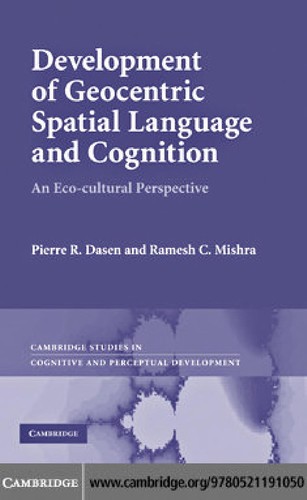
Development of Geocentric Spatial Language and Cognition
0
0
As an Amazon Associate and affiliate partner, Menrva Books earns from qualifying purchases. Learn more
Author Description
Egocentric spatial language uses coordinates in relation to our body to talk about small-scale space ('put the knife on the right of the plate and the fork on the left'), while geocentric spatial language uses geographic coordinates ('put the knife to the east, and the fork to the west'). How do children learn to use geocentric language? And why do geocentric spatial references sound strange in English when they are standard practice in other languages? This book studies child development in Bali, India, Nepal, and Switzerland and explores how children learn to use a geocentric frame both when speaking and performing non-verbal cognitive tasks (such as remembering locations and directions). The authors examine how these skills develop with age, look at the socio-cultural contexts in which the learning takes place, and explore the ecological, cultural, social, and linguistic conditions that favour the use of a geocentric frame of reference--Provided by publisher.
Menrva's Summary
THE THESIS
This book investigates the developmental trajectory of geocentric spatial language and cognition in children across diverse cultural contexts. It examines how children acquire the ability to use geographic coordinates for spatial reference, contrasting this with egocentric language, and explores why geocentric references are common in some languages but not others. The study draws on research conducted in Bali, India, Nepal, and Switzerland, analyzing the interplay of age, socio-cultural environments, and linguistic factors in shaping these cognitive skills.
THE SCOPE MAP
- A comparative study of geocentric spatial language acquisition in children from Bali, India, Nepal, and Switzerland.
- Analysis of the developmental progression of geocentric spatial skills with increasing age.
- Exploration of the socio-cultural contexts influencing the learning and use of geocentric frames of reference.
- Examination of ecological, cultural, social, and linguistic conditions that promote geocentric spatial orientation.
THE AUTHORITY PERSPECTIVE
This work offers a detailed comparative analysis of spatial language development, focusing on the under-researched geocentric frame of reference. Its cross-cultural methodology provides valuable insights into the interplay between language, cognition, and culture. The research is likely to be of significant interest to developmental psychologists, linguists, and anthropologists studying human cognition and cultural variation.
Page Count:
388
Publication Date:
2010-01-01
ISBN-10:
052119105X
ISBN-13:
9780521191050
Non-Fiction
Psychology
Literary Fiction
Developmental Psychology
Linguistics
Community Tags
Similar Books