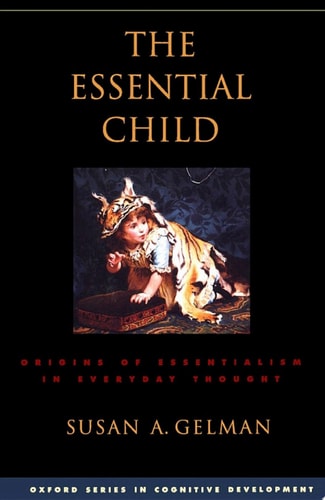
The Essential Child: Origins of Essentialism in Everyday Thought
0
0
As an Amazon Associate and affiliate partner, Menrva Books earns from qualifying purchases. Learn more
Author Description
Essentialism is the idea that certain categories, such as "dog," "man," or "intelligence," have an underlying reality or true nature that gives objects their identity. Where does this idea come from? In this book, Susan Gelman argues that essentialism is an early cognitive bias. Young children's concepts reflect a deep commitment to essentialism, and this commitment leads children to look beyond the obvious in many converging ways: when learning words, generalizing knowledge to new category members, reasoning about the insides of things, contemplating the role of nature versus nurture, and constructing causal explanations. Gelman argues against the standard view of children as concrete or focused on the obvious, instead claiming that children have an early, powerful tendency to search for hidden, non-obvious features of things. She also attacks claims that children build up their knowledge of the world based on simple, associative learning strategies, arguing that children's concepts are embedded in rich folk theories. Parents don't explicitly teach children to essentialize; instead, during the preschool years, children spontaneously construct concepts and beliefs that reflect an essentialist bias. Essentialist accounts have been offered, in one form or another, for thousands of years, extending back at least to Aristotle and Plato. Yet this book is the first to address the issues surrounding essentialism from a psychological perspective. Gelman synthesizes over 15 years of empirical research on essentialism into a unified framework and explores the broader lessons that the research imparts concerning, among other things, human concepts, children's thinking, and the ways in which language influences thought. This volume will appeal to developmental, cognitive, and social psychologists, as well as to scholars in cognitive science and philosophy.
Menrva's Summary
THE THESIS
This book investigates the origins and development of essentialism, questioning whether the tendency to perceive an underlying reality in categories is an innate cognitive bias in children. Susan A. Gelman, a professor of psychology, utilizes over 15 years of empirical research to challenge the traditional view that children are merely concrete thinkers. She argues that children possess a sophisticated, early-emerging tendency to search for non-obvious, hidden features of the world, which she frames as a foundational element of human conceptual development.
THE SCOPE MAP
What You Will Find
- Analysis of how children generalize knowledge and reason about category identity
- Examination of the intersection between language acquisition and conceptual development
- Synthesis of empirical studies regarding folk theories and nature versus nurture reasoning
Scope Limits
- The text does not provide a comprehensive history of philosophical essentialism beyond its psychological implications
- The research focuses primarily on early childhood development rather than adult cognitive shifts
THE AUTHORITY PERSPECTIVE
Experts recognize this work as a foundational text for understanding the cognitive mechanisms behind categorization and early childhood reasoning. Readers frequently note the academic density of the prose, which serves as a rigorous resource for professionals in developmental psychology and cognitive science.
Page Count:
383
Publication Date:
2005-01-01
Publisher:
Oxford University Press
ISBN-10:
0190623500
ISBN-13:
9780190623500
Psychology
Cognitive
Reference
Kindle Store
Words Language & Grammar
Kindle eBooks
Linguistics
Developmental Psychology
Categories
Counseling Psychology
Philosophy of
Community Tags
Similar Books