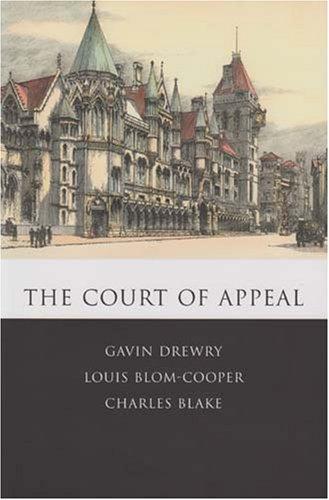
The Court of Appeal
0
0
As an Amazon Associate and affiliate partner, Menrva Books earns from qualifying purchases. Learn more
Author Description
Civil justice has been undergoing a massive transformation. There have been big changes in the management of judicial business; the Human Rights Act 1988 has had a pervasive impact; the Constitutional Reform Act 2005 has effected many changes - notably, the prospective transfer of the appellate jurisdiction of the House of Lords to a new Supreme Court. Against this backcloth of radical change, this book looks at the recent history and the present-day operation of the civil division of the Court of Appeal - a court that, despite its pivotal position, has attracted surprisingly little scholarly attention. It examines the impact of the permission to appeal requirements, and the way in which applications - particularly those by litigants in person - are handled; it looks at the working methods of the Lords Justices and at the leadership of the Court by recent Masters of the Rolls; it considers the relationship between the Court and the House of Lords - looking at high-profile cases in which the Court has been reversed by the Lords. Notwithstanding the impending arrival of the Supreme Court, it concludes that 'the Court of Appeal will remain firmly in place, occupying its crucial position as, to all intents and purposes, the court of last resort-indeed, a supreme court-for most civil appellants.'
Menrva's Summary
THE THESIS
The Court of Appeal stands as a pivotal, yet under-examined, institution within the transforming landscape of civil justice. This book investigates the recent history and current operations of the civil division of the Court of Appeal, a court whose significance has been overshadowed by broader legal reforms. It analyzes the impact of appeal permission requirements, the handling of applications (especially by those representing themselves), and the working methods of its judges. The study also considers the leadership of recent Masters of the Rolls and the Court's interactions with the House of Lords, particularly in cases where its decisions were overturned.
THE SCOPE MAP
- The impact of the Human Rights Act 1988 and the Constitutional Reform Act 2005 on civil justice.
- Analysis of the permission to appeal requirements and their effect on case handling.
- Examination of the working methods of Lords Justices and recent Masters of the Rolls.
- Consideration of the Court of Appeal's relationship with the House of Lords, including high-profile reversals.
- Discussion of the impending transfer of appellate jurisdiction to a new Supreme Court.
- The book's conclusion on the enduring importance of the Court of Appeal as a court of last resort for most civil appellants.
THE AUTHORITY PERSPECTIVE
This book offers a detailed examination of the English Court of Appeal's civil division during a period of significant legal change. It is likely to be of interest to legal scholars, practitioners, and students of the British judicial system. The analysis focuses on the practical workings and historical context of the court, providing insights into its role and future.
Page Count:
196
Publication Date:
2007-01-01
ISBN-10:
1841133876
ISBN-13:
9781841133874
History
Science
Non-Fiction
Judicial System
Law
Legal History
Community Tags
Similar Books