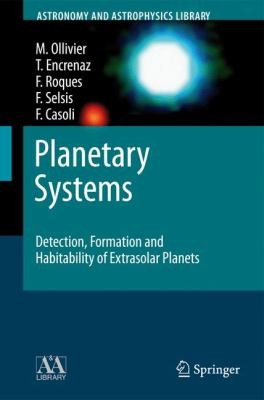
Planetary Systems: Detection, Formation and Habitability of Extrasolar Planets
0
0
As an Amazon Associate and affiliate partner, Menrva Books earns from qualifying purchases. Learn more
Author Description
Over the past ten years, the discovery of extrasolar planets has opened a new field of astronomy, and this area of research is rapidly growing, from both the observational and theoretical point of view. The presence of many giant exoplanets in the close vicinity of their star shows that these newly discovered planetary systems are very different from the solar system. New theoretical models are being developed in order to understand their formation scenarios, and new observational methods are being implemented to increase the sensitivity of exoplanet detections. In the present book, the authors address the question of planetary systems from all aspects. Starting from the facts (the detection of more than 300 extraterrestrial planets), they first describe the various methods used for these discoveries and propose a synthetic analysis of their global properties. They then consider the observations of young stars and circumstellar disks and address the case of the solar system as a specific example, different from the newly discovered systems. Then the study of planetary systems and of exoplanets is presented from a more theoretical point of view. The book ends with an outlook to future astronomical projects, and a description of the search for life on exoplanets. This book addresses students and researchers who wish to better understand this newly expanding field of research.
Menrva's Summary
THE THESIS
The discovery of extrasolar planets has fundamentally reshaped our understanding of planetary systems, revealing configurations vastly different from our own solar system. Over the past decade, this field has experienced rapid growth, driven by both observational advancements and theoretical modeling. The book details the methods used to detect these exoplanets, analyzes their global properties, and explores the formation scenarios for systems with giant planets close to their stars. It also contrasts these new systems with our solar system, examines young stars and circumstellar disks, and looks toward future projects, including the search for life beyond Earth.
THE SCOPE MAP
- Methods for detecting extrasolar planets, including observational techniques.
- Synthetic analysis of the global properties of discovered exoplanetary systems.
- Observations of young stars and circumstellar disks.
- Comparison of newly discovered systems with our solar system.
- Theoretical perspectives on the formation of planetary systems and exoplanets.
- Outlook on future astronomical projects in exoplanet research.
- Description of the search for life on exoplanets.
THE AUTHORITY PERSPECTIVE
This book is presented as a comprehensive resource for students and researchers entering the expanding field of exoplanetary science. It aims to provide a thorough understanding by covering factual discoveries, detection methodologies, theoretical models of formation, and future research directions. The text is structured to offer both observational and theoretical viewpoints, making it a valuable reference for those seeking to grasp the complexities of planetary systems beyond our own. The inclusion of future projects and the search for extraterrestrial life suggests a forward-looking perspective on the discipline.
Page Count:
340
Publication Date:
2008-01-01
ISBN-10:
3540757473
ISBN-13:
9783540757474
Science
Non-Fiction
Astrophysics
Planetary Science
Astronomy
Exoplanets
Community Tags
Similar Books