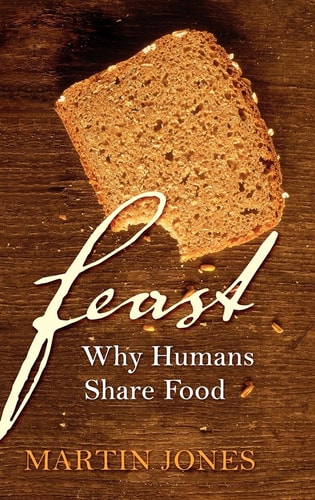
Feast: Why Humans Share Food
0
0
As an Amazon Associate and affiliate partner, Menrva Books earns from qualifying purchases. Learn more
Author Description
The family dinner, the client luncheon, the holiday spread--the idea of people coming together for a meal seems the most natural thing in the world. But that is certainly not the case for most other members of the animal kingdom. In Feast, archeologist Martin Jones presents both historic and modern scientific evidence to illuminate how prehistoric humans first came to share food and to trace the ways in which the human meal has shaped our cultural evolution.Jones shows that by studying the activities of our closest animal relative, the chimpanzee, and by unearthing ancient hearths, some more than 30,000 years old, scientists have been able to piece together a picture of how our ancient ancestors found, killed, cooked, and divided food. In sites uncovered all over the world, fragments of bone, remnants of charred food, pieces of stone or clay serving vessels, and the outlines of ancient halls tell the story of how we slowly developed the complex traditions of eating we recognize in our own societies today. Jones takes us on a tour of the most fascinating sites and artifacts that have been discovered, and shows us how archeologists have made many fascinating discoveries. In addition, he traces the rise of such recent phenomena as biscuits, "going out to eat," and the Thanksgiving-themed TV dinner.From the earliest evidence of human consumption around half a million years ago to the era of the drive-through diner, this fascinating account unfolds the history of the human meal and its profound impact on human society.
Menrva's Summary
THE THESIS
This book investigates the evolutionary and cultural origins of food sharing, questioning how and why the act of eating together became a defining characteristic of the human species. Archaeologist Martin H. Jones utilizes a combination of primatology, archaeological excavation data, and historical analysis to construct a framework for understanding the human meal. By examining evidence from ancient hearths and comparing human behavior to that of chimpanzees, Jones argues that the development of shared consumption was a critical driver in the evolution of human social structures and cultural traditions.
THE SCOPE MAP
What You Will Find
- Analysis of archaeological evidence from ancient hearths and food preparation sites dating back 30,000 years.
- Comparative studies of primate feeding behaviors to establish evolutionary baselines.
- Examination of material culture including stone tools, clay vessels, and ancient dining architecture.
- A historical trajectory of food consumption ranging from prehistoric hunting and gathering to modern industrial dining habits.
THE AUTHORITY PERSPECTIVE
Experts recognize this work as a comprehensive synthesis of archaeological data regarding human social evolution through the lens of nutrition. Readers frequently note the accessibility of the prose, which balances academic rigor with a clear, chronological narrative of human development.
Page Count:
384
Publication Date:
2007-03-29
Publisher:
Oxford University Press
ISBN-10:
0199209014
ISBN-13:
9780199209019
History
Archaeology
Sociology
Anthropology
Cultural Anthropology
Food History
Community Tags
Similar Books