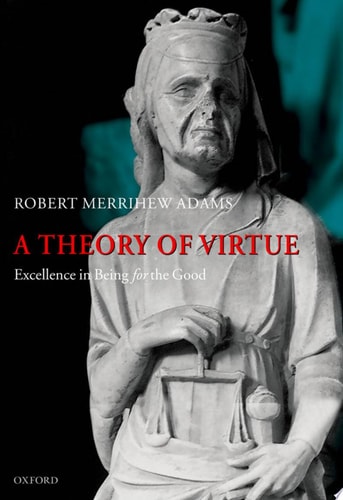
A Theory of Virtue: Excellence in Being for the Good
0
0
As an Amazon Associate and affiliate partner, Menrva Books earns from qualifying purchases. Learn more
Author Description
The distinguished philosopher Robert M. Adams presents a major work on virtue, which is once again a central topic in ethical thought. A Theory of Virtue is a systematic, comprehensive framework for thinking about the moral evaluation of character. Many recent attempts to stake out a place in moral philosophy for this concern define virtue in terms of its benefits for the virtuous person or for human society more generally. In Part One Adams presents and defends a conception of virtue as intrinsic excellence of character, worth prizing for its own sake and not only for its benefits. In the other two parts he addresses two challenges to the ancient idea of excellence of character.One challenge arises from the importance of altruism in modern ethical thought, and the question of what altruism has to do with intrinsic excellence. Part Two argues that altruistic benevolence does indeed have a crucial place in excellence of character, but that moral virtue should also be expected to involve excellence in being for other goods besides the well-being (and the rights) of other persons. It explores relations among cultural goods, personal relationships, one's own good, and the good of others, as objects of excellent motives.The other challenge, the subject of Part Three of the book, is typified by doubts about the reality of moral virtue, arising from experiments and conclusions in social psychology. Adams explores in detail the prospects for an empirically realistic conception of excellence of character as an object of moral aspiration, endeavor, and education. He argues that such a conception will involve renunciation of the ancient thesis of the unity or mutual implication of all virtues, and acknowledgment of sufficient 'moral luck' in the development of any individual's character to make virtue very largely a gift, rather than an individual achievement, though nonetheless excellent and admirable for that.
Menrva's Summary
THE THESIS
This work investigates the nature of moral virtue by proposing a systematic framework that defines virtue as an intrinsic excellence of character rather than merely a functional benefit. Robert Merrihew Adams, a distinguished philosopher, utilizes historical ethical traditions and contemporary psychological data to construct his argument. He posits that virtue is worth prizing for its own sake, while simultaneously addressing how altruism and modern empirical findings regarding human behavior impact our understanding of moral character.
THE SCOPE MAP
What You Will Find
- A comprehensive philosophical framework for the moral evaluation of character.
- An analysis of the role of altruistic benevolence within the context of intrinsic excellence.
- A critical examination of social psychology experiments that challenge the traditional concept of moral virtue.
- A discussion on the influence of moral luck and the rejection of the ancient thesis regarding the unity of all virtues.
THE AUTHORITY PERSPECTIVE
Experts recognize this text as a significant contribution to contemporary virtue ethics, particularly for its attempt to reconcile ancient ideals with modern psychological skepticism. Readers frequently note the academic density of the prose, which requires a strong background in philosophical discourse to fully grasp the nuances of Adams's arguments.
Page Count:
264
Publication Date:
2006-12-07
Publisher:
Clarendon Press
ISBN-10:
0199207518
ISBN-13:
9780199207510
Non-Fiction
Philosophy
Moral Philosophy
Ethics
Community Tags
Other Editions(2)
Similar Books




Reader Comments
Share Your Thoughts
No comments yet. Be the first to share your thoughts!