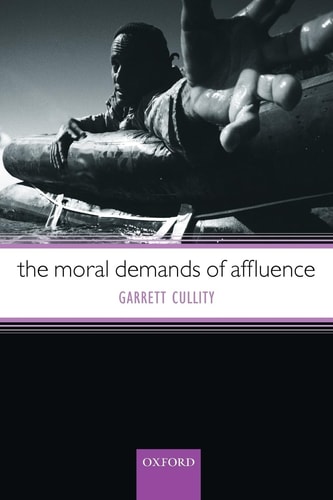
The Moral Demands of Affluence
0
0
As an Amazon Associate and affiliate partner, Menrva Books earns from qualifying purchases. Learn more
Author Description
How much are we morally required to do to help people who are much worse off than us? Philosophers have often raised this question in assessing the plausibility of particular moral theories. But it is a pressing question whatever one's moral outlook. Any plausible moral outlook should recognize requirements of beneficence -- requirements grounded directly in other people's need for assistance. Given this, there is a forceful case for thinking that we are morally required -- not only collectively, but also as individuals -- to devote a substantial proportion of what we have to helping the poor.One way to present this case is by means of a simple analogy: an analogy between giving money to an aid agency and rescuing a needy person directly. Part I of Garrett Cullity's book examines this analogy in detail, discussing the ways in which it is politically and metaphysically simplistic. However, there remains an important truth in the simple analogy. It is that we are morally required to help.In one way, our world imposes a radical separation between its rich and poor inhabitants: our material circumstances are starkly different. In another way, however, it does not: the human experiences and fulfillments of rich and poor are fundamentally the same. This is an important part of the case for thinking that their welfare grounds requirements of beneficence on us to help them. But Part II shows that it is also part of the case for limiting those requirements. Drawing attention to the range of goods that ground requirements on us to help each other, Cullity argues that these requirements only make sense on the assumption that a life of a certain kind -- a life that is not restricted in an extremely demanding way -- is one that it is not wrong for us to live.
Menrva's Summary
THE THESIS
This book investigates the extent of our individual moral obligations to assist those living in extreme poverty. Garrett Cullity, a philosopher specializing in moral theory, evaluates the strength of arguments for beneficence by analyzing the relationship between personal wealth and the needs of the global poor. He constructs a framework that balances the moral imperative to provide aid against the necessity of maintaining a life that is not excessively restricted by those very demands.
THE SCOPE MAP
What You Will Find
- A critical examination of the analogy between direct rescue and charitable donation.
- An analysis of the metaphysical and political complexities inherent in global aid.
- A philosophical argument regarding the limits of beneficence based on the value of a balanced human life.
- A discussion on the shared human experiences that ground moral requirements across disparate economic circumstances.
THE AUTHORITY PERSPECTIVE
Experts recognize this work as a rigorous contribution to the literature on global justice and individual moral duty. Readers frequently note the academic density of the prose, which is intended for those engaged in serious ethical inquiry.
Page Count:
296
Publication Date:
2006-11-23
Publisher:
Clarendon Press
ISBN-10:
0199204152
ISBN-13:
9780199204151
Philosophy
Ethics
Political Philosophy
Moral and ethical aspects
Community Tags
Other Editions(2)
Similar Books