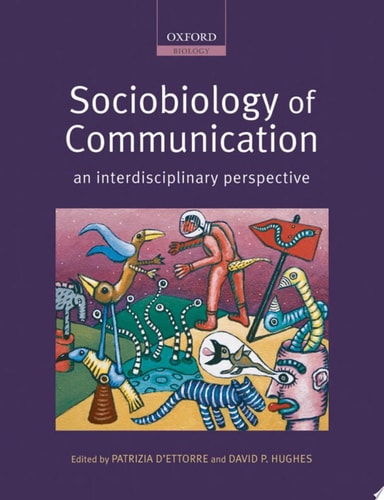
Sociobiology of Communication: An Interdisciplinary Perspective
0
0
As an Amazon Associate and affiliate partner, Menrva Books earns from qualifying purchases. Learn more
Author Description
Communication is essential for all forms of social interaction, from parental care to mate choice and cooperation. This is evident for human societies but less obvious for bacterial biofilms, ant colonies or flocks of birds. The major disciplines of communication research have tried to identify common core principles, but syntheses have been few because historical barriers have limited interaction between different research fields.Sociobiology of Communication is a timely and novel synthesis. It bridges many of the gaps between proximate and ultimate levels of analysis, between empirical model systems, and between biology and the humanities. The book offers the complementary approaches of a distinguished group of authors spanning a large diversity of research programs, addressing, for example, the genetic basis of bacterial communication, dishonest communication in insect societies, sexual selection and network communication among colonial vertebrates. Other chapters explore the role of communication in genomic conflict and self-organisation, and how linguistics, psychology and philosophy may ultimately contribute to a biological understanding of human mate choice and the evolution of human societies.This highly interdisciplinary book highlights key examples of modern research to explore the genetic, neurobiological, physiological, chemical and behavioural basis of social communication. It identifies where consensus on the general principles is emerging and where the major future challenges are to be found. The book is therefore suitable for both for graduate students and professionals in evolutionary biology and behavioural ecology seeking novel inspiration, and for a wider academic audience, including social and medical scientists who would like to explore what evolutionary approaches can offer to their fields.
Menrva's Summary
THE THESIS
This book investigates the core principles of social communication across diverse biological systems, seeking to unify disparate research fields into a cohesive evolutionary framework. The authors, David P. Hughes and Patrizia d'Ettorre, curate a collection of expert contributions that bridge the gap between proximate mechanisms—such as genetics and neurobiology—and ultimate evolutionary outcomes. By integrating perspectives from biology, linguistics, psychology, and philosophy, the text argues for a multi-level analysis of how information exchange facilitates cooperation, mate choice, and social organization in species ranging from bacteria to humans.
THE SCOPE MAP
What You Will Find
- Analysis of communication mechanisms in bacterial biofilms, insect societies, and colonial vertebrates.
- Exploration of the genetic, neurobiological, physiological, and chemical foundations of social signaling.
- Examination of complex phenomena including dishonest communication, genomic conflict, and self-organization.
- Interdisciplinary synthesis connecting evolutionary biology with the humanities and social sciences.
THE AUTHORITY PERSPECTIVE
Experts identify this work as a significant interdisciplinary resource for graduate students and professionals in evolutionary biology and behavioral ecology. Readers frequently note the academic density of the prose, which serves as a foundational text for those seeking to integrate biological approaches into social and medical research fields.
Page Count:
320
Publication Date:
2008-10-15
Publisher:
Oxford University Press
ISBN-10:
0199216835
ISBN-13:
9780199216833
Science
Evolutionary Biology
Communication research
Sociobiology
Communication Studies
Biology
Behavioral Ecology
Communication
Community Tags
Other Editions(2)

Similar Books













Reader Comments
Share Your Thoughts
No comments yet. Be the first to share your thoughts!