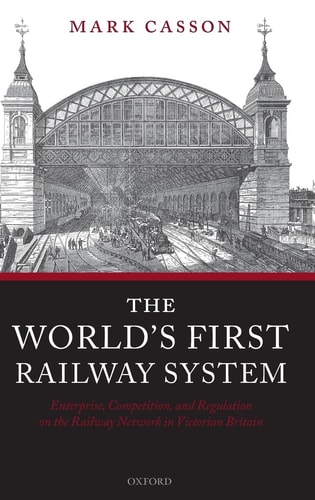
The World's First Railway System: Enterprise, Competition, and Regulation on the Railway Network in Victorian Britain
0
0
As an Amazon Associate and affiliate partner, Menrva Books earns from qualifying purchases. Learn more
Author Description
The British railway network was a monument to Victorian private enterprise. Its masterpieces of civil engineering were emulated around the world. But its performance was controversial: praised for promoting a high density of lines, it was also criticised for wasteful duplication of routes.This is the first history of the British railway system written from a modern economic perspective. It uses conterfactual analysis to construct an alternaive network to represent the most efficient alternative rail network that could have been constructed given what was known at the time - the first time this has been done. It reveals how weaknesses in regulation and defects in government policy resulted in enormous inefficiency in the Victorian system that Britain lives with today.British railway companies developed into powerful regional monopolies, which then contested each other's territories. When denied access to existing lines in rival territories, they built duplicate lines instead. Plans for an integrated national system, sponsored by William Gladstone, were blocked by Members of Parliament because of a perceived conflict with the local interests they represented. Each town wanted more railways than its neighbours, and so too many lines were built. The costs of these surplus lines led ultimately to higher fares and freight charges, which impaired the performance of the economy.The book will be the definitive source of reference for those interested in the economic history of the British railway system. It makes use of a major new historical source, deposited railway plans, integrates transport and local history through its regional analysis of the railway system, and provides a comprehensive, classified bibliography.
Menrva's Summary
THE THESIS
This book investigates the economic efficiency and regulatory failures of the British railway network during the Victorian era. Author Mark Casson, an expert in business history and economics, utilizes a modern analytical framework to evaluate the development of the rail system. By applying counterfactual analysis to historical data, the text argues that government policy and local political interests led to significant infrastructure duplication and long-term economic inefficiency.
THE SCOPE MAP
What You Will Find
- A comprehensive economic analysis of the Victorian railway network development.
- Counterfactual modeling of an alternative, more efficient rail infrastructure.
- Examination of the impact of regional monopolies and territorial competition on national transport policy.
- Integration of primary source material, specifically deposited railway plans and regional historical data.
THE AUTHORITY PERSPECTIVE
Experts recognize this work as a significant contribution to the economic history of British infrastructure, noting its rigorous application of modern analytical tools to historical datasets. Readers frequently highlight the text's detailed regional analysis and its utility as a foundational reference for understanding the long-term economic consequences of Victorian-era regulatory decisions.
Page Count:
448
Publication Date:
2009-11-09
Publisher:
Oxford University Press
ISBN-10:
0199213976
ISBN-13:
9780199213979
History
Economics
Transportation
Business History
Railroads
British History
Victorian Era
Community Tags
Similar Books