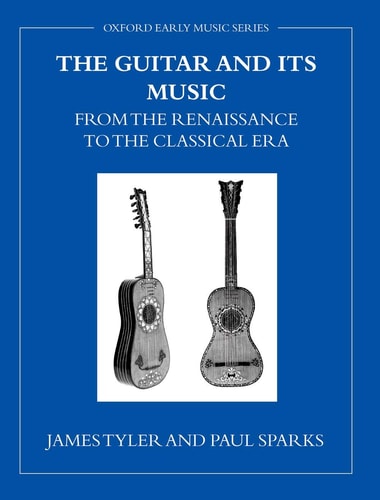
The Guitar and Its Music: From the Renaissance to the Classical Era
0
0
As an Amazon Associate and affiliate partner, Menrva Books earns from qualifying purchases. Learn more
Author Description
Following on from James Tyler's The Early Guitar: A History and Handbook(O.U.P. 1980) this collaboration with Paul Sparks (their previous book for O.U.P., The Early Mandolin, appeared in 1989), presents new ideas and research on the history and development of the guitar and its music from the Renaissance to the dawn of the Classical era. Tyler's systematic study of the two main guitar types found between about 1550 and 1750 focuses principally on what the sources of the music (published and manuscript) and the writings of contemporary theorists reveal about the nature of the instruments and their roles in the music making of the period. The annotated lists of primary sources, previously published in The Early Guitar but now revised and expanded, constitute the most comprehensive bibliography of Baroque guitar music to date. His appendices of performance practice information should also prove indispensable to performers and scholars alike. Paul Sparks also breaks new ground, offering an extensive study of a period in the guitar's history-notably c.1759-c.1800-which the standard histories usually dismiss in a few short paragraphs. Far from being a dormant instrument at this time, the guitar is shown to have been central to music-making in France, Italy, the Iberian Peninsula, and South America. Sparks provides a wealth of information about players, composers, instruments, and surviving compositions from this neglected but important period, and he examines how the five-course guitar gradually gave way to the six-string instrument, a process that occurred in very different ways (and at different times) in France, Italy, Spain, Germany, and Britain.
Menrva's Summary
THE THESIS
This book investigates the historical evolution, technical development, and musical role of the guitar from the Renaissance through the late eighteenth century. Authors James Tyler and Paul Sparks utilize a combination of primary source analysis, contemporary theoretical writings, and bibliographical research to challenge the notion that the guitar was a dormant instrument during the late eighteenth century. By examining the transition from the five-course instrument to the six-string guitar, the authors provide a rigorous framework for understanding the instrument's cultural significance across Europe and South America.
THE SCOPE MAP
What You Will Find
- A comprehensive bibliography of Baroque guitar music, including revised and expanded annotated lists of primary sources.
- Detailed analysis of the transition from the five-course guitar to the six-string instrument across various European regions.
- Historical documentation of players, composers, and surviving compositions from the neglected period of 1750 to 1800.
- Appendices focused on performance practice, offering technical insights for both scholars and practicing musicians.
THE AUTHORITY PERSPECTIVE
Experts recognize this work as a foundational text for musicologists and performers interested in the early history of the guitar. Readers frequently note the academic density of the prose and the meticulous nature of the research provided by the authors.
Page Count:
322
Publication Date:
2007-01-25
Publisher:
Oxford
ISBN-10:
0199214778
ISBN-13:
9780199214778
Music
Musicology
Reference
Music History
Community Tags
Other Editions(3)
Similar Books


Reader Comments
Share Your Thoughts
No comments yet. Be the first to share your thoughts!