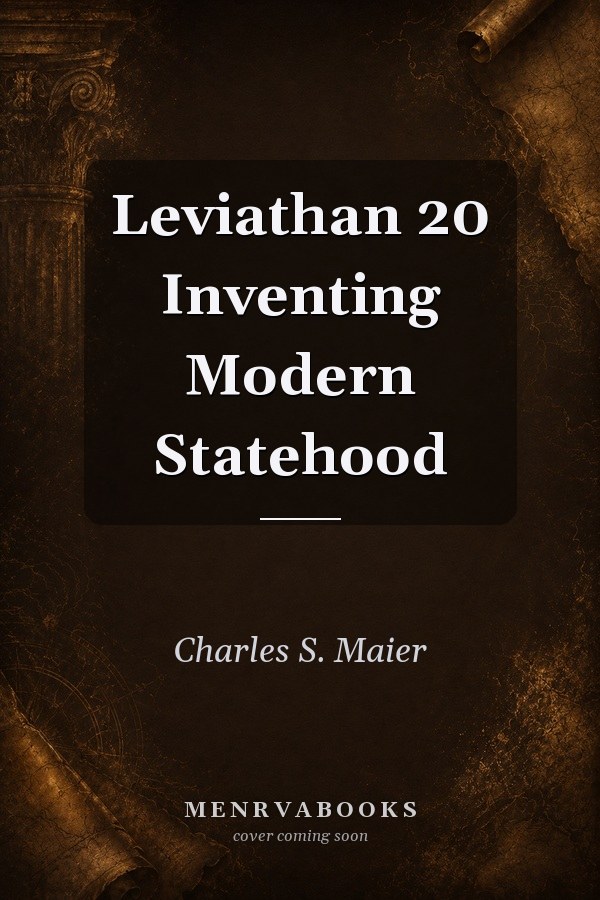
Leviathan 2.0: Inventing Modern Statehood
0
0
As an Amazon Associate and affiliate partner, Menrva Books earns from qualifying purchases. Learn more
Author Description
Thomas Hobbes laid the theoretical groundwork of the nation-state in Leviathan, his tough-minded treatise of 1651. Leviathan 2.0 updates this classic account to explain how modern statehood took shape between the mid-nineteenth and mid-twentieth centuries, before it unraveled into the political uncertainty that persists today. Modern states were far from immune to the modernizing forces of war, technology, and ideology. From 1845 to 1880, the United States, Canada, Mexico, and Argentina were all reconstituted through territorial violence. Europe witnessed the unification of Germany and Italy, while Asian nations such as Japan tried to mitigate foreign incursions through state-building reforms. A global wave of revolution at the turn of the century pushed the modernization process further in China, Russia, Iran, and Ottoman Turkey. By the late 1930s, with the rise of the Soviet Union and Nazi Germany, the momentum of history seemed to shift toward war-glorifying totalitarian states. But several variants of the modern state survived World War II: the welfare states of Western democracies; single-party socialist governments; and governments dominated by the military, especially prevalent in Latin America, Asia, and the Middle East. Toward the end of the twentieth century, all of these forms stood in growing tension with the transformative influences of globalized capitalism. Modern statehood recreated itself in many ways, Maier concludes, but finally had to adopt a precarious equilibrium with ever more powerful economic forces.--
Menrva's Summary
THE THESIS
This book investigates the complex evolution and eventual precariousness of modern statehood from the mid-nineteenth to the late twentieth century. Charles S. Maier, drawing on his extensive background in history and political science, examines how forces such as war, technology, and ideology reshaped states globally. The book analyzes specific historical periods, including the reconstitution of nations through violence, the rise of unified European states, and the impact of revolutions and totalitarian regimes. Maier ultimately argues that while modern statehood has continuously recreated itself, it now exists in a delicate balance with powerful global economic forces.
THE SCOPE MAP
- Analysis of state formation and transformation between 1845 and the late 20th century.
- Case studies of state reconstitution through territorial violence in the Americas.
- Examination of European state unification and Asian responses to foreign incursions.
- Exploration of revolutionary waves and the rise of totalitarian states.
- Discussion of post-World War II state variants: welfare states, socialist governments, and military-dominated regimes.
- Assessment of the impact of globalized capitalism on modern statehood.
THE AUTHORITY PERSPECTIVE
The book is recognized for its comprehensive historical analysis of modern statehood, tracing its development and the challenges it faced throughout the 19th and 20th centuries. Maier's work is noted for its detailed examination of the forces that shaped and reshaped states, from violent conflict to ideological shifts and economic globalization. The analysis highlights the diverse forms modern states have taken and their ongoing struggle to maintain equilibrium in a rapidly changing world. The book offers a nuanced perspective on the historical trajectory of state power and its contemporary vulnerabilities.
Page Count:
370
Publication Date:
2014-01-01
ISBN-10:
0674281322
ISBN-13:
9780674281325
Politics
History
Non-Fiction
Sociology
Community Tags
Similar Books