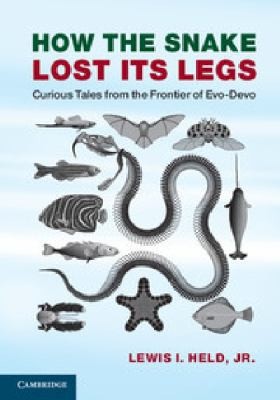
How the Snake Lost Its Legs: Curious Tales From the Frontier of Evodevo
0
0
As an Amazon Associate and affiliate partner, Menrva Books earns from qualifying purchases. Learn more
Author Description
How did the zebra really get its stripes, and the giraffe its long neck? What is the science behind camel humps, leopard spots, and other animal oddities? Such questions have fascinated us for centuries, but the expanding field of evo-devo (evolutionary developmental biology) is now providing, for the first time, a wealth of insights and answers. Taking inspiration from Kipling's 'Just So Stories', this book weaves emerging insights from evo-devo into a narrative that provides startling explanations for the origin and evolution of traits across the animal kingdom. Held's unique and engaging style makes this narrative both enlightening and entertaining, guiding students and researchers through even complex concepts and encouraging a fuller understanding of the latest developments in the field. The first five chapters cover the first bilaterally symmetric animals, flies, butterflies, snakes, and cheetahs. A final chapter surveys recent results about a menagerie of other animals
Menrva's Summary
THE THESIS
Evolutionary developmental biology offers new explanations for the diverse physical traits of animals. Lewis I. Held, Jr., drawing inspiration from Kipling's 'Just So Stories,' explores the science behind animal oddities like zebra stripes, giraffe necks, and leopard spots. The book synthesizes emerging insights from evo-devo to provide startling explanations for the origin and evolution of these characteristics across the animal kingdom. Held's engaging style makes complex concepts accessible to students and researchers alike, fostering a deeper understanding of the field's latest developments.
THE SCOPE MAP
- Exploration of the evolutionary origins of animal traits, inspired by 'Just So Stories'.
- Focus on evolutionary developmental biology (evo-devo) as a source of insights.
- Detailed examination of specific animal examples: zebras, giraffes, camels, leopards, snakes, and cheetahs.
- Coverage of the first bilaterally symmetric animals.
- Discussion of recent findings on a wide variety of other animal species.
- Accessible explanation of complex concepts for students and researchers.
- Narrative approach to scientific explanation, making the material enlightening and entertaining.
THE AUTHORITY PERSPECTIVE
The book is presented as an enlightening and entertaining narrative that makes complex concepts in evolutionary developmental biology accessible to students and researchers. Its approach, inspired by 'Just So Stories,' aims to provide startling explanations for animal traits. The author's engaging style is highlighted as a key feature for encouraging a fuller understanding of the field's latest developments. The structure, beginning with early bilateral animals and progressing through specific examples like snakes and cheetahs, suggests a logical and comprehensive exploration of the subject matter.
Page Count:
285
Publication Date:
2014-01-01
ISBN-10:
1107621399
ISBN-13:
9781107621398
Non-Fiction
Science
Animals
Zoology
Developmental Biology
Evolutionary Biology
Community Tags
Similar Books