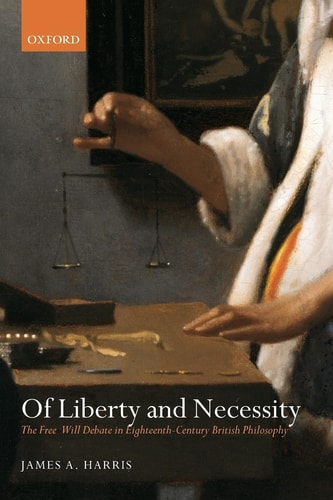
Of Liberty and Necessity: The Free Will Debate in Eighteenth-century British Philosophy
0
0
As an Amazon Associate and affiliate partner, Menrva Books earns from qualifying purchases. Learn more
Author Description
In Of Liberty and Necessity James A. Harris presents the first comprehensive account of the free will problem in eighteenth-century British philosophy. Harris proposes new interpretations of the positions of familiar figures such as Locke, Hume, Edwards, and Reid. He also gives careful attention to writers such as William King, Samuel Clarke, Anthony Collins, Lord Kames, James Beattie, David Hartley, Joseph Priestley, and Dugald Stewart, who, while well-known in the eighteenth century, have since been largely ignored by historians of philosophy. Through detailed textual analysis, and by making precise use of a variety of different contexts, Harris elucidates the contribution that each of these writers makes to the eighteenth-century discussion of the will and its freedom.In this period, the question of the nature of human freedom is posed principally in terms of the influence of motives upon the will. On one side of the debate are those who believe that we are free in our choices. A motive, these philosophers believe, constitutes a reason to act in a particular way, but it is up to us which motive we act upon. On the other side of the debate are those who believe that, on the contrary, there is no such thing as freedom of choice. According to these philosophers, one motive is always intrinsically stronger than the rest and so is the one that must determine choice. Several important issues are raised as this disagreement is explored and developed, including the nature of motives, the value of "indifference" to the will's freedom, the distinction between "moral" and "physical" necessity, the relation between the will and the understanding, and the internal coherence of the concept of freedom of will.One of Harris's primary objectives is to place this debate in the context of the eighteenth-century concern with replicating in the mental sphere what Newton had achieved in the philosophy of nature. All of the philosophers discussed in Of Liberty and Necessity conceive of themselves as "experimental" reasoners, and, when examining the will, focus primarily upon what experience reveals about the influence of motives upon choice. The nature and significance of introspection is therefore at the very center of the free will problem in this period, as is the question of what can legitimately be inferred from observable regularities in human behavior.
Menrva's Summary
THE THESIS
This book investigates the evolution and internal logic of the free will debate within eighteenth-century British philosophy. James A. Harris, a scholar of early modern thought, examines how philosophers of the era attempted to apply Newtonian scientific principles to the study of the human mind. By analyzing the tension between motive-based determinism and the concept of autonomous choice, Harris provides a framework for understanding how these thinkers navigated the intersection of moral responsibility and physical necessity.
THE SCOPE MAP
What You Will Find
- A comprehensive survey of eighteenth-century British philosophical discourse on the will.
- Detailed textual analysis of major figures including Locke, Hume, Edwards, and Reid.
- Examination of neglected thinkers such as William King, Anthony Collins, and Joseph Priestley.
- A thematic exploration of the distinction between moral and physical necessity.
THE AUTHORITY PERSPECTIVE
Scholars recognize this work as a definitive account of the period's philosophical landscape, particularly for its inclusion of lesser-known figures. Readers frequently note the academic density of the prose, which is intended for those with a background in philosophical history.
Page Count:
280
Publication Date:
2008-02-17
Publisher:
Oxford University Press
ISBN-10:
0199234752
ISBN-13:
9780199234752
Philosophy
History
Intellectual History
Philosophy history
Ethics
Metaphysics
Community Tags
Similar Books

Reader Comments
Share Your Thoughts
No comments yet. Be the first to share your thoughts!