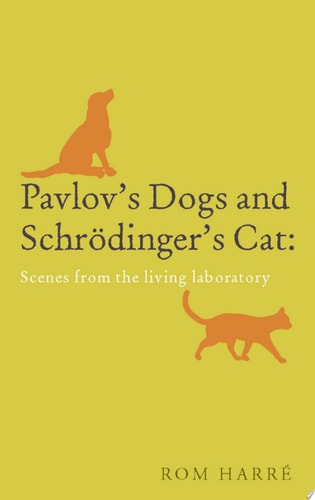
Pavlov's Dogs and Schrödinger's Cat: Scenes from the Living Laboratory
0
0
As an Amazon Associate and affiliate partner, Menrva Books earns from qualifying purchases. Learn more
Author Description
From the sheep, dog, and cockerel that were sent aloft in Montgolfier's balloon to test the air over Paris, to the famous clone Dolly the Sheep and the Darwinian finches of the Galapagos, Pavlov's Dogs and Schrödinger's Cat offers a fascinating and enlightening look at the use of plants and animals--including humans--in scientific experiments. Rom Harré here provides a fresh and fascinating perspective on research, setting aside moral reflection to simply examine the history of how and why living creatures have been used for the purposes of discovery. Ranging over five centuries, the book uncovers many extraordinary stories, including tales of the people involved, to many curious incidents and episodes, and the occasional scientific fraud. From Gregor Mendel's use of pea plants to explore heredity, to Barry Marshall's use of himself as the experimental animal in his helicobacter experiments (he survived) and even the use of an imaginary cat in Schrödinger's famous thought experiment, the reader discovers here a perspective on scientific work he or she has never encountered before--the concept of the "living laboratory."
Menrva's Summary
THE THESIS
This book investigates the historical and conceptual role of living organisms as instruments within the scientific laboratory. Rom Harré, a philosopher and psychologist, examines the evolution of experimental practices involving plants, animals, and humans over five centuries. By framing these subjects as components of a 'living laboratory,' the author provides a historical analysis of how biological entities have been utilized to advance empirical discovery. The text avoids ethical debate to focus on the mechanics and motivations behind these experimental choices.
THE SCOPE MAP
What You Will Find
- Historical accounts of animal subjects in experiments, from early balloon flights to modern cloning.
- Analysis of the 'living laboratory' framework as a tool for scientific inquiry.
- Case studies ranging from Mendel's pea plants to human self-experimentation.
- Examination of thought experiments, such as Schrödinger's cat, as conceptual tools.
THE AUTHORITY PERSPECTIVE
Experts and readers often note the unique, interdisciplinary approach Harré takes in bridging history and philosophy of science. The text is frequently cited for its ability to synthesize disparate scientific anecdotes into a cohesive, accessible narrative for those interested in the history of research methods.
Page Count:
322
Publication Date:
2010-04-05
Publisher:
Oxford University Press
ISBN-10:
019923857X
ISBN-13:
9780199238576
History
Science
Science
Scientific History
Earth Sciences
Botany history
Biology
Community Tags
Similar Books