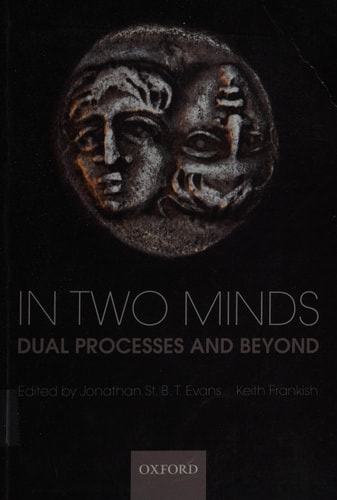
In Two Minds: Dual Processes and Beyond
0
0
As an Amazon Associate and affiliate partner, Menrva Books earns from qualifying purchases. Learn more
Author Description
This book explores the idea that we have two minds - one that is automatic, unconscious, and fast, the other controlled, conscious, and slow. In recent years there has been great interest in so-called dual-process theories of reasoning and rationality. According to dual processs theories, there are two distinct systems underlying human reasoning - an evolutionarily old system that is associative, automatic, unconscious, parallel, and fast, and a more recent, distinctively human system that is rule-based, controlled, conscious, serial, and slow. Within the former, processes are held to be innate and to use heuristics which evolved to solve specific adaptive problems. In the latter, processes are taken to be learned, flexible, and responsive to rational norms.Despite the attention these theories are attracting, there is still poor communication between dual-process theorists themselves, and the substantial bodies of work on dual processes in cognitive psychology and social psychology remain isolated from each other. This book brings together leading researchers on dual-processes to summarize the state of the art, highlight key issues, present different perspectives, explore implications, and provide a stimulus to further work.It includes new ideas about the human mind both by contemporary philosophers interested in broad theoretical questions about mental architecture and by psychologists specialising in traditionally distinct and isolated fields. For all those in the cognitive sciences, this is a book that will advance dual-process theorizing, promote interdisciplinary communication, and encourage further applications of dual-process approaches.
Menrva's Summary
THE THESIS
This book investigates the validity and implications of dual-process theories, which posit that human cognition is governed by two distinct systems: an automatic, fast, unconscious process and a controlled, slow, conscious process. Editors Jonathan J. Evans and Keith Frankish compile contributions from leading psychologists and philosophers to bridge the gap between isolated research fields. The text evaluates the current state of dual-process theorizing, aiming to synthesize disparate findings from cognitive and social psychology into a unified framework for understanding mental architecture.
THE SCOPE MAP
What You Will Find
- Comparative analysis of associative versus rule-based reasoning systems.
- Theoretical frameworks regarding the evolutionary origins of heuristic-based cognition.
- Interdisciplinary perspectives from both cognitive psychologists and philosophers of mind.
- Critical evaluation of the communication barriers between different sub-fields of cognitive science.
THE AUTHORITY PERSPECTIVE
Experts recognize this volume as a foundational resource for those seeking to understand the complexities of dual-process models in contemporary cognitive science. Readers frequently note the academic density of the prose, which serves as a comprehensive reference for researchers and advanced students in the field.
Page Count:
369
Publication Date:
2009-04-15
Publisher:
Oxford University Press
ISBN-10:
0199230161
ISBN-13:
9780199230167
Psychology
Non-Fiction
Philosophy
Consciousness
Neuroscience
Thought And Thinking
Community Tags
Similar Books