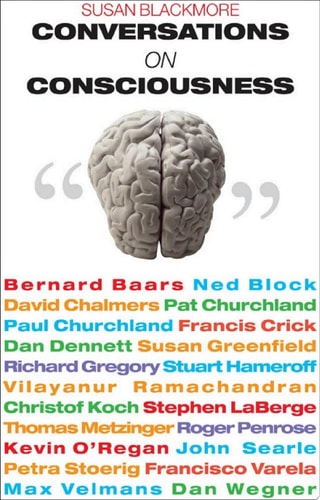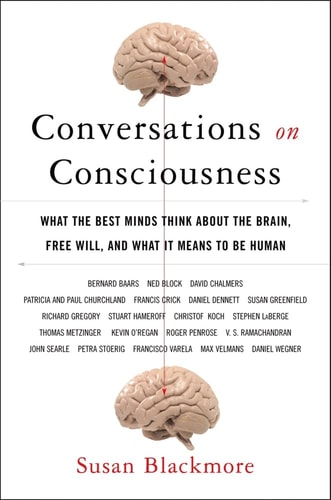
Conversations on Consciousness: What the Best Minds Think about the Brain, Free Will, and What It Means to Be Human
0
0
As an Amazon Associate and affiliate partner, Menrva Books earns from qualifying purchases. Learn more
Author Description
Human brains are just the most complicated thing that's yet evolved, and we're trying to understand them using our brains," notes philosopher Daniel Dennett. "We're trying to reverse engineer ourselves, to understand what kind of a machine we are."In Conversations on Consciousness, Susan Blackmore brings together some of the great minds of our time, a who's who of eminent thinkers, all of whom have devoted much of their lives to understanding "what kind of a machine we are." Some of the interviewees are major philosophers (such as John Searle, Ned Block, and David Chalmers) and some are equally renowned scientists (Francis Crick, Roger Penrose, V.S. Ramachandran). All of them talk candidly with Blackmore about some of the key philosophical issues confronting us, in a series of conversations that are revealing, insightful, and stimulating. They ruminate on the nature of consciousness--is it something apart from the brain? Is it even possible to understand the brain, to understand human consciousness? Some of these thinkers say no, it isn't possible, but most believe that we will pierce the mystery surrounding consciousness, and that neuroscience will provide the key. Blackmore goes beyond the issue of consciousness to ask other intriguing questions: Is there free will (a question which yields many conflicted replies, with most saying yes and no); if no, how does this effect the way you live your life; and more broadly, how has your work changed the way you live.Ranging from the curious (do bees have consciousness?) to the profound (is our sense of having a self just an illusion), these provocative conversations illuminate current thinking on the mind and on human nature itself.
Menrva's Summary
THE THESIS
This book investigates the fundamental nature of human consciousness and the possibility of reconciling subjective experience with biological brain function. Susan Blackmore, a psychologist and writer, utilizes her expertise to facilitate a series of interviews with leading philosophers and neuroscientists. The text serves as a structured inquiry into whether human consciousness is a solvable scientific mystery or an inherent limitation of our own cognitive architecture.
THE SCOPE MAP
What You Will Find
- Interviews with prominent thinkers including Daniel Dennett, John Searle, and Francis Crick.
- Philosophical debates regarding the existence of free will and the nature of the self.
- Scientific perspectives on the biological mechanisms of the brain.
- Explorations into the limits of human understanding and the potential for future neuroscientific discovery.
THE AUTHORITY PERSPECTIVE
Experts and readers frequently cite this collection as a highly accessible entry point into the complex field of consciousness studies. The text is noted for its ability to distill dense philosophical and scientific arguments into clear, conversational exchanges.
Page Count:
288
Publication Date:
2006-01-01
Publisher:
Oxford University Press
ISBN-10:
0195179587
ISBN-13:
9780195179583
Science
Non-Fiction
Philosophy
Psychology
Neuroscience
Consciousness
Community Tags
Similar Books