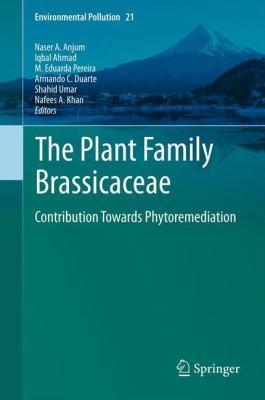
The Plant Family Brassicaceae Contribution Towards Phytoremediation
0
0
As an Amazon Associate and affiliate partner, Menrva Books earns from qualifying purchases. Learn more
Author Description
With the advent of the Industrial Revolution, the biosphere has been continuously polluted with a myriad of contaminants that urgently need global attention. In this perspective, most of the genera of the plant family Brassicaceae (Crucifereae or the mustard family) are significant parts of the plants- and associated microbes-based strategies adopted for the cleanup of varied contaminants from environmental compartments. Important genera such as Alyssum, Arabidopsis, Brassica and Thlaspi from Brassicaceae which, besides acting as attractive genetic models, well-represent the metal hyperaccumulation among approximately 0.2% of all angiosperms and thus, play a key role in the phytoremediation technology. This book i) provides an exhaustive evaluation of the current status of contaminants (metals/metalloids)-addition to varied environmental compartments and its consequences, ii) offers comprehensive and state-of-the-art information on the significance of the plants from the family Brassicaceae in solving environmental pollution issues, iii) examines the physiological, biochemical and molecular-genetic strategies adopted by the plants from Brassicaceae for the remediation of and tolerance to varied environmental contaminants, and iv) supplies a broad reference to the field of environmental science and related disciplines. As a pioneer work on the subject and significant addition to the Environmental Pollution book series, the current volume promises to be a useful asset for researchers, students, other academics and policy makers involved in sustainable remediation of varied environmental compartments.
Menrva's Summary
THE THESIS
The urgent need to address widespread environmental pollution drives an investigation into the role of the Brassicaceae plant family in phytoremediation. The book evaluates the current status of contaminants and their consequences, offering comprehensive information on how plants from the Brassicaceae family contribute to solving environmental pollution issues. It examines the physiological, biochemical, and molecular-genetic strategies these plants employ for remediation and tolerance to various contaminants. This work serves as a broad reference for researchers, students, academics, and policymakers involved in sustainable environmental cleanup.
THE SCOPE MAP
- Evaluation of the current status of contaminants and their consequences.
- Comprehensive information on the significance of Brassicaceae plants in environmental pollution solutions.
- Examination of physiological, biochemical, and molecular-genetic strategies for remediation and tolerance.
- Focus on key genera such as Alyssum, Arabidopsis, Brassica, and Thlaspi.
- Discussion of metal hyperaccumulation in plants.
- Reference for environmental science and related disciplines.
THE AUTHORITY PERSPECTIVE
This book is presented as a significant addition to the Environmental Pollution series, aiming to provide researchers, students, academics, and policymakers with comprehensive information on phytoremediation using the Brassicaceae family. The content is structured to offer an exhaustive evaluation of contaminants and detailed insights into the plants' remediation strategies. Its scope suggests it is a valuable resource for those involved in environmental science and sustainable cleanup efforts.
Page Count:
339
Publication Date:
2012-01-01
ISBN-10:
9400739125
ISBN-13:
9789400739123
Science
Non-Fiction
Nature
Bioremediation
Pollution Control
Botany
Community Tags
Similar Books