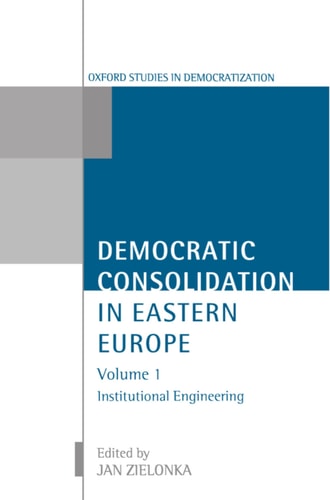
Democratic Consolidation in Eastern Europe: Volume 1: Institutional Engineering
0
0
As an Amazon Associate and affiliate partner, Menrva Books earns from qualifying purchases. Learn more
Author Description
This volume--the first in a series of books on democratic consolidation in Eastern Europe--examines the constraints and opportunities of institutional engineering in Eastern Europe. The aim is to contrast a set of democracy theories with empirical evidence accumulated in Eastern Europe over the last ten years. Avoiding complex debates about definitions, methods, and the uses and misuses of comparative research, this book instead tries to establish what has really happened in the region and which of the existing theories have proved helpful in explaining these developments.
Menrva's Summary
THE THESIS
This volume investigates the efficacy of institutional engineering in facilitating democratic consolidation across post-communist Eastern Europe. Jan Zielonka, a prominent scholar in European studies, utilizes a decade of empirical data to evaluate how various political theories align with the actual transition processes observed in the region. By prioritizing observable outcomes over abstract methodological debates, the author provides a framework for understanding which structural reforms successfully stabilized new democratic systems.
THE SCOPE MAP
What You Will Find
- Comparative analysis of institutional design in post-communist states
- Evaluation of democratic theory against decade-long empirical evidence
- Assessment of constitutional and electoral system impacts on stability
- Identification of successful and failed political engineering strategies
THE AUTHORITY PERSPECTIVE
Experts recognize this work as a foundational text for understanding the complexities of political transition in the former Eastern Bloc. Scholars frequently cite the book for its pragmatic approach to evaluating institutional performance during the critical decade following the collapse of communism.
Page Count:
512
Publication Date:
2001-08-16
Publisher:
Oxford University Press
ISBN-10:
0199241678
ISBN-13:
9780199241675
Democracy
Eastern Europe
Comparative Politics
Politics & Government
Institutional Design
Constitutional History
Europe Eastern
Community Tags
Similar Books