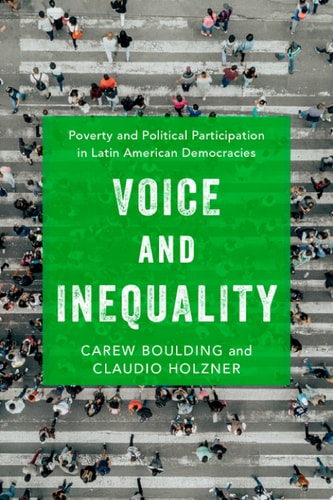
Voice and Inequality: Poverty and Political Participation in Latin American Democracies
0
0
As an Amazon Associate and affiliate partner, Menrva Books earns from qualifying purchases. Learn more
Author Description
The first large-scale study of political participation in eighteen Latin American democracies, focusing on the political participation of the region's poorest citizens.Political regimes in Latin America have a long history of excluding poor people from politics. Today, the region's democracies survive in contexts that are still marked by deep poverty and some of the world's most severe socioeconomic inequalities. Keeping socioeconomic inequality from spilling over into political inequality is one of the core challenges facing these young democracies. In Voice and Inequality, Carew Boulding and Claudio Holzner offer the first large-scale empirical analysis of political participation in Latin America. They find that in recent years, most (but not all) countries in the region have achieved near equality of participation across wealth groups, and in some cases poor people participate more than wealthier individuals. How can this be, given the long history of excluding poor people from the political arena in Latin America?Boulding and Holzner argue that key institutions of democracy, namely civil society, political parties, and competitive elections, have an enormous impact on whether or not poor people turn out to vote, protest, and contact government officials. Far from being politically inert, under certain conditions the poorest citizens can act and speak for themselves with an intensity that far exceeds their modest socioeconomic resources. When voluntary organizations thrive in poor communities and when political parties focus their mobilization efforts on poor individuals, they respond with high levels of political activism. Poor people's activism also benefits from strong parties, robust electoral competition and well-functioning democratic institutions. Where electoral competition is robust and where the power of incumbents is constrained, the authors find higher levels of participation by poor individuals and more political equality.
Menrva's Summary
THE THESIS
This book investigates how socioeconomic inequality influences political participation among the poorest citizens within Latin American democracies. Authors Carew Boulding and Claudio A. Holzner utilize extensive empirical data across eighteen countries to challenge the assumption that poverty inherently leads to political exclusion. They argue that the presence of robust civil society organizations, active political parties, and competitive electoral environments can effectively mobilize poor populations to participate in the political process at rates equal to or exceeding those of wealthier citizens.
THE SCOPE MAP
What You Will Find
- A comprehensive empirical analysis of political participation across eighteen Latin American nations.
- An examination of the role of civil society, political parties, and elections in mobilizing marginalized groups.
- Quantitative data comparing political activism levels between different socioeconomic wealth groups.
- A framework for understanding how democratic institutional strength mitigates the impact of economic inequality on political voice.
THE AUTHORITY PERSPECTIVE
Scholars and political scientists recognize this work as a foundational empirical study on the intersection of inequality and democratic engagement in the Global South. Readers frequently note the academic rigor of the methodology and the clarity with which the authors connect institutional design to citizen behavior.
Page Count:
264
Publication Date:
2021-01-01
Publisher:
Oxford University Press
ISBN-10:
0197542166
ISBN-13:
9780197542163
Comparative Politics
Poverty
Sociology
Democracy
Politics & Government
Community Tags
Similar Books



Reader Comments
Share Your Thoughts
No comments yet. Be the first to share your thoughts!