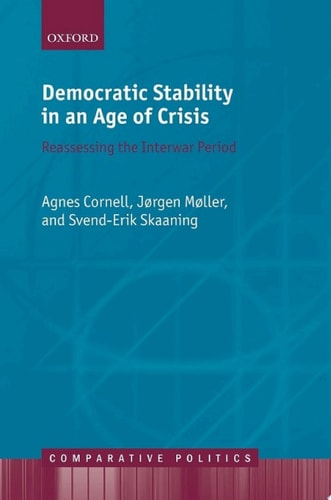
Democratic Stability in an Age of Crisis: Reassessing the Interwar Period
0
0
As an Amazon Associate and affiliate partner, Menrva Books earns from qualifying purchases. Learn more
Author Description
The interwar period has left a deep impression on later generations. This was an age of crises where representative democracy, itself a relatively recent political invention, seemed unable to cope with the challenges that confronted it. Against the backdrop of the economic crisis that began in 2008 and the rise of populist parties, a new body of scholarship - frequently invoked by the media - has used interwar political developments to warn that even long-established Western democracies are fragile. Democratic Stability in an Age of Crisis challenges this 'interwar analogy' based on the fact that a relatively large number of interwar democracies were able to survive the recurrent crises of the 1920s and 1930s. The main aim of this book is to understand the striking resilience of these democracies, and how they differed from the many democracies that broke down in the same period. The authors advance an explanation that emphasizes the importance of democratic legacies and the strength of the associational landscape (i.e., organized civil society and institutionalized political parties). Moreover, they underline that these factors were themselves associated with a set of deeper structural conditions, which on the eve of the interwar period had brought about different political pathways. The authors' empirical strategy consists of a combination of comparative analyses of all interwar democratic spells and illustrative case studies. The book's main takeaway point is that the interwar period shows how resilient democracy is once it has had time to consolidate. On this basis, recent warnings about the fragility of contemporary democracies in Western Europe and North America seem exaggerated - or, at least, that they cannot be sustained by interwar evidence. Comparative Politics is a series for researchers, teachers, and students of political science that deals with contemporary government and politics. Global in scope, books in the series are characterized by a stress on
Menrva's Summary
THE THESIS
This book investigates the factors that enabled certain democracies to survive the systemic crises of the interwar period while others collapsed. The authors, Agnes Cornell, Jørgen Møller, and Svend-Erik Skaaning, utilize a comparative political framework to challenge the prevailing 'interwar analogy' often applied to contemporary democratic fragility. By analyzing the structural conditions and institutional legacies of the 1920s and 1930s, they argue that consolidated democracies possess a resilience that is frequently underestimated in modern political discourse.
THE SCOPE MAP
What You Will Find
- A comprehensive comparative analysis of all democratic spells occurring during the interwar period.
- An examination of the role of civil society and institutionalized political parties in democratic survival.
- Illustrative case studies contrasting resilient democracies with those that experienced breakdown.
Scope Limits
- The analysis focuses primarily on the interwar period and does not provide a detailed policy manual for modern democratic governance.
- The study does not cover non-Western democratic developments outside the scope of the interwar comparative dataset.
THE AUTHORITY PERSPECTIVE
Experts in comparative politics identify this work as a rigorous empirical challenge to historical analogies currently used in political science. Readers frequently note the academic density of the prose, which is intended for researchers and students of political science.
Page Count:
236
Publication Date:
2020-01-01
Publisher:
OUP Oxford
ISBN-10:
0191899062
ISBN-13:
9780191899065
History
Comparative Politics
Democracy
Community Tags
Similar Books


Reader Comments
Share Your Thoughts
No comments yet. Be the first to share your thoughts!