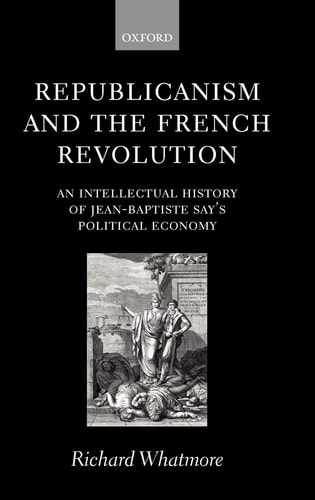
Republicanism and the French Revolution: An Intellectual History of Jean-Baptiste Say's Political Economy
0
0
As an Amazon Associate and affiliate partner, Menrva Books earns from qualifying purchases. Learn more
Author Description
This book provides a new interpretation of political thought and political economy in France from the death of Louis XVI to the July revolution of 1830. The clash between modern republicanism and other theories of governing societies is the background to a thorough interpretation of the life and writings of Jean-Baptiste Say, the most famous political economist of the post-revolutionary era.
Menrva's Summary
THE THESIS
This book investigates how the evolution of republican thought in post-revolutionary France shaped the development of political economy through the work of Jean-Baptiste Say. Richard Whatmore, a scholar of intellectual history, examines the ideological conflicts between republicanism and competing governance theories from the execution of Louis XVI to the 1830 July Revolution. By situating Say within this volatile political landscape, the author argues that his economic theories were not merely technical, but were deeply embedded in the search for a stable, post-revolutionary political order.
THE SCOPE MAP
What You Will Find
- Analysis of French political thought between 1793 and 1830
- Examination of the intellectual intersection between republicanism and political economy
- Detailed biographical and analytical study of Jean-Baptiste Say
- Contextualization of economic theory within the broader history of political ideas
THE AUTHORITY PERSPECTIVE
Scholars of intellectual history recognize this work as a significant contribution to understanding the political origins of classical economics in France. Readers frequently note the academic density of the prose and the author's meticulous use of primary source materials to reconstruct the ideological climate of the era.
Page Count:
264
Publication Date:
2001-01-11
Publisher:
Oxford University Press
ISBN-10:
0199241155
ISBN-13:
9780199241156
Economics
History
Intellectual History
Economists
French History
Economics history
Community Tags
Similar Books