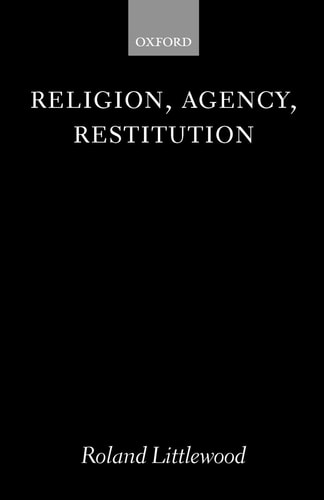
Religion, Agency, Restitution
0
0
As an Amazon Associate and affiliate partner, Menrva Books earns from qualifying purchases. Learn more
Author Description
Professor Little wood marshals arguments that help us understand more clearly how we interactively use religion and science/healing to come to terms with the world around us. He draws in part on his clinical work as a psychiatrist with patients from religious movements in the West, but primarily on his earlier anthropological fieldwork with a new African-Caribbean religion in Trinidad, and more recently with ethical transformations in the older Caribbean cults and among the ultra-Orthodox Jewish Hasidim. There exists a close relationship between the explanations of misfortune, reconciliation, and restitution in the historical - and other - religions and in therapeutics. Professor Little wood believes that cosmological and redemptive assumptions exist in any type of healing, whether physical or psychological. Spiritual and healing theories interact in surprising ways, and he examines the religious aspect in systems of therapeutics as well as the appearance of healing practices within social institutions that are generally regarded as religious.
Menrva's Summary
THE THESIS
This work investigates the fundamental intersection between religious belief systems and therapeutic practices, questioning how individuals utilize these frameworks to interpret misfortune and seek restitution. Roland Littlewood, a psychiatrist and anthropologist, synthesizes his clinical observations with extensive fieldwork to argue that healing—whether psychological or physical—is inherently tied to cosmological and redemptive assumptions. By examining diverse cultural and religious groups, he demonstrates that the mechanisms used to reconcile personal suffering are often shared between spiritual institutions and medical systems.
THE SCOPE MAP
What You Will Find
- Comparative analysis of healing practices in African-Caribbean religious movements and ultra-Orthodox Jewish communities.
- Examination of the relationship between explanations of misfortune and the pursuit of social or spiritual restitution.
- Integration of clinical psychiatric experience with anthropological fieldwork methodologies.
- Theoretical exploration of how redemptive assumptions function within modern therapeutic institutions.
THE AUTHORITY PERSPECTIVE
Scholars in medical anthropology and the sociology of religion frequently cite this text for its nuanced approach to the overlap between belief and clinical practice. Experts highlight the author's ability to bridge the gap between psychiatric theory and ethnographic observation, making it a significant contribution to the study of therapeutic systems.
Page Count:
186
Publication Date:
1987-03-26
Publisher:
Oxford University Press M.D.
ISBN-10:
0199246750
ISBN-13:
9780199246755
Religion
Natural theology
Medical Anthropology
Sociology
Psychiatry
Anthropology
Religious Aspects
Religion and sociology
Community Tags
Similar Books