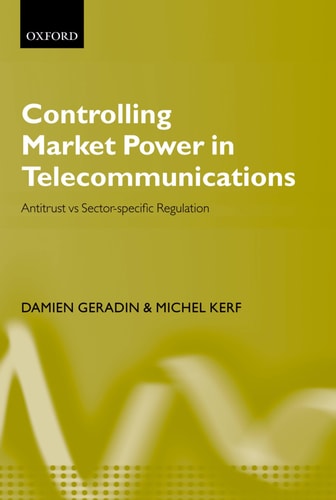
Controlling Market Power in Telecommunications: Antitrust vs. Sector-Specific Regulation
0
0
As an Amazon Associate and affiliate partner, Menrva Books earns from qualifying purchases. Learn more
Author Description
Controlling market power is a crucial issue in liberalized telecommunications market where incumbents usually remain dominant for some time after the opening of the market to competition. Controlling market power can be achieved through two distinct sets of rules and institutions: economy-wide antitrust rules and institutions, which have been in place in most industrialized countries for several decades, and infrastructure or sector-specific rules and institutions which have been specifically adopted to promote competition and control market power in telecommunications or in particular infrastructure sectors. In this context, the relationship between the two sets of rules and institutions becomes an issue of growing importance. Relying on a comparative analysis of five countries (the United States, New Zealand, the United Kingdom, Chile and Australia), the present book seeks to shed some light on how economy-wide and infrastructure or sector-specific components of the regulatory framework should be designed and on what the respective roles of such components should be to maximize the efficiency of economic regulation in telecommunications.
Menrva's Summary
THE THESIS
This book investigates the optimal balance between economy-wide antitrust enforcement and sector-specific regulatory frameworks in liberalized telecommunications markets. The authors, Damien Geradin and Michel Kerf, utilize a comparative legal and economic analysis to evaluate how different jurisdictions manage the transition from incumbent monopolies to competitive environments. By examining the interplay between general competition law and industry-specific oversight, the text provides a framework for designing regulatory structures that maximize economic efficiency and market competition.
THE SCOPE MAP
What You Will Find
- Comparative analysis of telecommunications regulation in the United States, New Zealand, the United Kingdom, Chile, and Australia.
- Evaluation of the institutional roles of antitrust authorities versus sector-specific regulators.
- Assessment of market liberalization strategies for infrastructure-heavy industries.
- Methodological framework for designing regulatory components to control incumbent market power.
THE AUTHORITY PERSPECTIVE
Experts recognize this work as a foundational text for understanding the intersection of competition law and telecommunications policy. Readers frequently note the academic density of the prose, which provides a rigorous examination of regulatory design for legal and economic professionals.
Page Count:
401
Publication Date:
2003-04-03
Publisher:
Oxford University Press
ISBN-10:
0199242437
ISBN-13:
9780199242436
Business
Economics
Law
Antitrust
Public Policy
Telecommunications
Law And Legislation
Community Tags
Similar Books