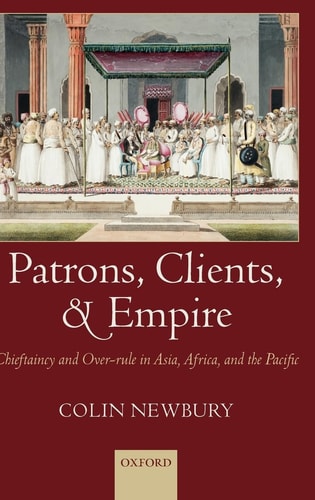
Patrons, Clients, and Empire: Chieftaincy and Over-rule in Asia, Africa, and the Pacific
0
0
As an Amazon Associate and affiliate partner, Menrva Books earns from qualifying purchases. Learn more
Author Description
This is a wide-ranging comparative study of relationships between the indigenous leadership of traditional states and colonizing Europeans from the seventeenth to the twentieth century. It challenges stereotypes of despotic imperial power in Asian, African, and Pacific colonies and seeks to answer the fundamental question: how were European officials able to govern so many societies over such a long period of time? Colin Newbury examines the politics of pre-colonial state structures, their subversion by merchants and administrators, and the use made of indigenous leaders, and assesses the legacy of these colonial hierarchies.
Menrva's Summary
THE THESIS
This book investigates the mechanisms of colonial governance by examining how European powers utilized indigenous leadership structures to maintain control over diverse societies across Asia, Africa, and the Pacific. Colin W. Newbury, a distinguished historian of colonial administration, utilizes a comparative framework to analyze the interaction between traditional chieftaincy and imperial bureaucracy. By synthesizing historical data from the seventeenth to the twentieth century, the author argues that colonial rule was rarely a monolithic imposition of power but rather a complex system of patronage and clientelism. The work challenges simplistic narratives of despotic control, proposing instead that the longevity of imperial rule relied heavily on the strategic co-option of local elites.
THE SCOPE MAP
What You Will Find
- Comparative analysis of colonial administrative practices across three distinct geographical regions.
- Examination of pre-colonial state structures and their subsequent subversion by European merchants and officials.
- Case studies detailing the political relationships between indigenous leaders and colonial authorities.
- Assessment of the long-term institutional legacies left by colonial hierarchies in post-colonial states.
THE AUTHORITY PERSPECTIVE
Scholars and historians frequently cite this work as a foundational text for understanding the nuances of indirect rule and imperial administration. Readers often note the academic density of the prose, which provides a rigorous, data-driven look at the political mechanics of empire.
Page Count:
344
Publication Date:
2003-04-10
Publisher:
Oxford University Press
ISBN-10:
0199257817
ISBN-13:
9780199257812
History
Imperialism
Colonialism
Sociology
Community Tags
Similar Books