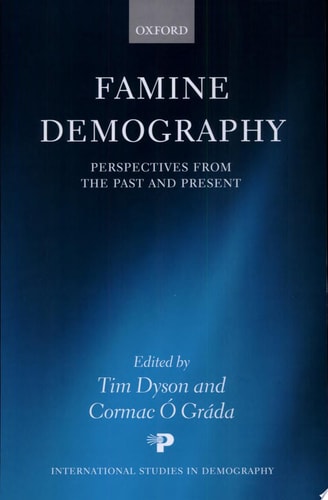
Famine Demography: Perspectives from the Past and Present
0
0
As an Amazon Associate and affiliate partner, Menrva Books earns from qualifying purchases. Learn more
Author Description
This book deals with the important subject of famine demography. It describes case studies of the demography of historical and more recent famines in locations as far apart as Ireland, Finland, India, Burundi, Russia, Greece, Madagascar, and Japan. The authors concern themselves with significant issues such as the role of famines in controlling population growth in the past, the nature of interactions between starvation and epidemic diseases during times of famine, and the detailed demographic consequences of famines. In the latter category issues such as the age and cause-specific profiles of excess famine mortality receive particular attention. This is the only comparative volume of its kind. It is wide-ranging in time and place, but at the same time focuses sharply on a particular subject. Consequently its contents provide a unique understanding of famine demography.
Menrva's Summary
THE THESIS
This volume investigates the demographic mechanisms and long-term population impacts of famine across diverse historical and contemporary contexts. The authors, Cormac Ó Gráda and Tim Dyson, utilize a comparative analytical framework to synthesize data from global case studies, ranging from 19th-century Ireland to modern-day crises. By examining the intersection of starvation, epidemic disease, and mortality patterns, the text argues that famine functions as a complex demographic event rather than a simple Malthusian check on population growth.
THE SCOPE MAP
What You Will Find
- Comparative analysis of famine events in Ireland, Finland, India, Burundi, Russia, Greece, Madagascar, and Japan.
- Quantitative assessment of age-specific and cause-specific excess mortality profiles.
- Investigation into the synergistic relationship between nutritional deprivation and the spread of infectious diseases.
- Evaluation of historical population growth trends in relation to recurring famine cycles.
THE AUTHORITY PERSPECTIVE
Experts recognize this work as a foundational comparative study that bridges historical demography and contemporary crisis analysis. Readers frequently note the academic density of the prose and the rigorous reliance on empirical data to support its demographic conclusions.
Page Count:
295
Publication Date:
2002-06-27
Publisher:
Oxford University Press
ISBN-10:
0199251916
ISBN-13:
9780199251919
History
Economics
Sociology
Famines
Public Health
Mortality
Demography
Community Tags
Similar Books