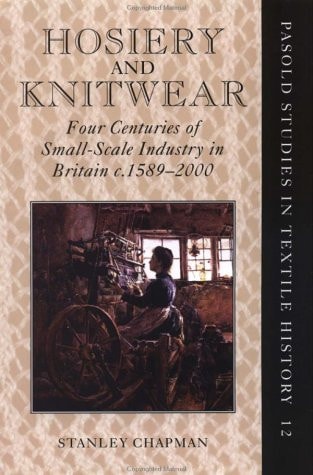
Hosiery and Knitwear: Four Centuries of Small-Scale Industry in Britain, c. 1589-2000
0
0
As an Amazon Associate and affiliate partner, Menrva Books earns from qualifying purchases. Learn more
Author Description
Hoisery and knitwear is familiar as a traditional British industry of small-scale family firms. This pioneer study traces in rich detail the tensions between internal aspirations of leaders (craftmanship, lifestyle, and supporting infrastructure) and external pressures (banks, wholesalers, chain store groups, and takeovers). The industry's history is traced from its beginnings in the early 1600s down to the end of the twentieth century.
Menrva's Summary
THE THESIS
This study investigates the historical trajectory of the British hosiery and knitwear industry to determine how small-scale family firms navigated the evolving pressures of industrialization and corporate consolidation over four centuries. Stanley Chapman, a noted economic historian, utilizes extensive archival research and business records to document the structural shifts within this sector. The work argues that the industry's survival was defined by a constant tension between the internal values of craftsmanship and lifestyle maintenance versus the external demands of financial institutions and retail conglomerates. By examining the period from 1589 to 2000, the author provides a comprehensive framework for understanding the resilience and eventual transformation of traditional manufacturing models.
THE SCOPE MAP
What You Will Find
- A chronological analysis of the British hosiery and knitwear sector from the late 16th century to the turn of the 21st century.
- Examination of the transition from artisanal, small-scale family operations to modern corporate structures.
- Analysis of the influence exerted by external entities such as banks, wholesalers, and chain store groups.
- Case studies detailing the impact of market takeovers and shifting economic infrastructure on local production.
THE AUTHORITY PERSPECTIVE
Experts recognize this work as a foundational text for understanding the evolution of British textile manufacturing and small-firm economics. Readers frequently note the academic density of the prose and the meticulous attention to historical detail provided by the author.
Page Count:
342
Publication Date:
2002-12-26
Publisher:
Oxford University Press
ISBN-10:
0199255679
ISBN-13:
9780199255672
History
Industries
British History
Economic History
Business History
Textile industry
Community Tags
Similar Books