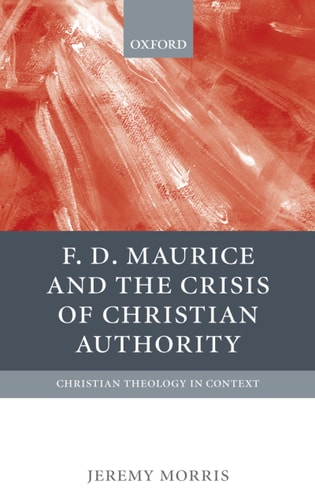
F. D. Maurice and the Crisis of Christian Authority
0
0
As an Amazon Associate and affiliate partner, Menrva Books earns from qualifying purchases. Learn more
Author Description
F. D. Maurice was a leading nineteenth-century theologian famous for founding the movement called Christian Socialism. In the first major reassessment of Maurice's work for many years, Jeremy Morris argues that his importance above all lay in his thinking about the Christian Church, and about its social role. At a time when many people feared the collapse of Christianity and of social order, Maurice tried to show that Christians, despite their many differences, had a responsibility to the whole of society. By appreciating the source and strength of each other's convictions, they could learn to work together to restore the authority of the Christian faith. It was the Church of England's task in particular to bring its message of hope to the poor as well as the rich.
Menrva's Summary
THE THESIS
This work investigates how F. D. Maurice navigated the perceived collapse of Christian authority and social order in nineteenth-century Britain. Jeremy Morris, a scholar of ecclesiastical history, utilizes primary theological texts and historical records to argue that Maurice’s primary contribution was his redefinition of the Church’s social responsibility. The book posits that Maurice’s vision of Christian Socialism was not merely political, but a theological attempt to unify disparate convictions to restore the institutional relevance of the Church of England.
THE SCOPE MAP
What You Will Find
- An analysis of nineteenth-century British ecclesiastical and social history.
- A detailed examination of the foundational principles of Christian Socialism.
- A reassessment of F. D. Maurice’s theological writings on the role of the Church.
- A study of the relationship between religious conviction and social order.
THE AUTHORITY PERSPECTIVE
Scholars recognize this text as a significant modern reassessment of Maurice’s intellectual legacy. Readers frequently note the academic density of the prose, which provides a rigorous framework for understanding the intersection of Victorian theology and social reform.
Page Count:
250
Publication Date:
2005-05-19
Publisher:
Oxford University Press
ISBN-10:
0199263167
ISBN-13:
9780199263165
History
Biography
Religion
Christian Theology
Social History
Community Tags
Similar Books