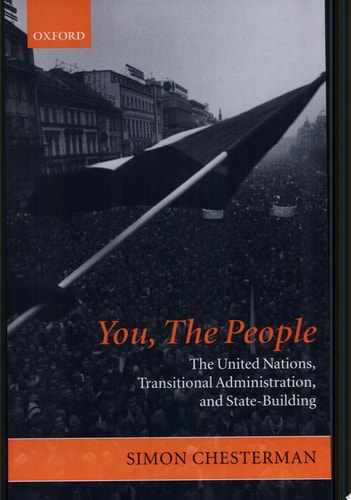
You, the People: The United Nations, Transitional Administration, and State-Building
0
0
As an Amazon Associate and affiliate partner, Menrva Books earns from qualifying purchases. Learn more
Author Description
The governance of post-conflict territories embodies a central contradiction: how does one help a population prepare for democratic governance and the rule of law by imposing a form of benevolent autocracy?Transitional administrations represent the most complex operations attempted by the United Nations. The operations in East Timor and Kosovo are commonly seen as unique in the history of the UN--perhaps never to be repeated. But they may also be seen as the latest in a series of operations that have involved the United Nations in 'state-building' activities, where it has attempted to develop the institutions of government by assuming some or all of those sovereign powers on a temporary basis. The circumstances that have demanded such interventions certainly will be repeated.Seen in the context of earlier UN operations, such as those in Namibia, Cambodia, and Eastern Slavonia, the view that these exceptional circumstances may not recur is somewhat disingenuous. Moreover, the need for such policy research has been brought into sharp focus by the weighty but ambiguous role assigned to the UN in Afghanistan and the possibility of a comparable role in Iraq.This book fills that gap. Aimed at policy-makers, diplomats, and a wide academic audience (including international relations, political science, international law, and war studies), the book provides a concise history of UN state-building operations and a treatment of the five key issues confronting such an operation on the ground: peace and security, the role of the UN as government, judicial reconstruction, economic reconstruction, and exit strategies.
Menrva's Summary
THE THESIS
This book investigates the inherent contradiction of utilizing temporary, externally imposed authority to establish long-term democratic governance and the rule of law in post-conflict territories. Simon Chesterman, a scholar in international law and policy, utilizes historical data from various United Nations missions to analyze the complexities of state-building. He argues that while operations in places like East Timor and Kosovo are often viewed as unique, they represent a recurring pattern of UN intervention that requires a more rigorous policy framework for future success.
THE SCOPE MAP
What You Will Find
- A historical analysis of UN state-building operations including Namibia, Cambodia, and Eastern Slavonia.
- A thematic breakdown of five critical operational challenges: peace and security, governance, judicial reconstruction, economic development, and exit strategies.
- Examination of the legal and political implications of the UN assuming sovereign powers.
- Comparative study of intervention mandates in Afghanistan and Iraq.
THE AUTHORITY PERSPECTIVE
Experts and academics in the field of international relations frequently cite this work as a foundational text for understanding the mechanics of transitional administration. Readers often note the academic density of the prose, which serves as a comprehensive resource for policy-makers and students of international law alike.
Page Count:
320
Publication Date:
2004-05-20
Publisher:
Oxford University Press
ISBN-10:
0199263485
ISBN-13:
9780199263486
History
International relations
War Studies
International Law
Armed Forces
Governance
Community Tags
Other Editions(2)
Similar Books