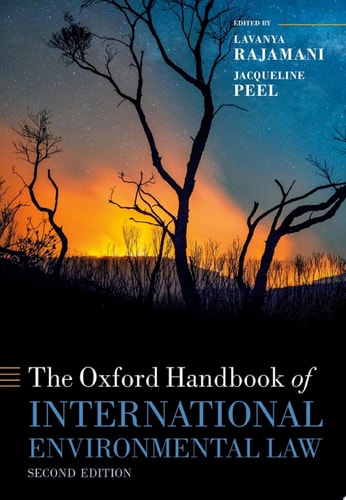
The Oxford Handbook of International Environmental Law
0
0
As an Amazon Associate and affiliate partner, Menrva Books earns from qualifying purchases. Learn more
Author Description
The second edition of this leading reference work provides a comprehensive discussion of the dynamic and important field of international law concerned with environmental protection. It is edited by globally-recognised international environmental law scholars, Professor Lavanya Rajamani and Professor Jacqueline Peel, and features 67 chapters authored by 76 renowned experts in their fields. The Handbook discusses the key principles underpinning international environmental law, its relevant actors and tools, and rules applying in its substantive sub-fields such as climate law, oceans law, wildlife and biodiversity law, and hazardous substances regulation. It also explores the intersection of international environmental law with other areas of international law, such as those concerned with trade, investment, disaster, migration, armed conflict, intellectual property, energy, and human rights. The Handbook sets its discussion of international environmental law in the broader interdisciplinary context of developments in science, ethics, politics and economics, which inform the way in which environmental rules are made, implemented, and enforced. It provides an introduction to the foundations of international environmental law while also engaging with questions at the frontiers of research, teaching, and practice in the field, including the role of Global South perspectives, the contribution made by Earth jurisprudence, and the growing role of a diverse range of actors from indigenous peoples to business and industry. Like the first edition, this second edition of the Handbook is an essential reference text for all engaged with environmental issues at the international level and the applicable governance and regulatory structures.
Menrva's Summary
THE THESIS
This handbook investigates the foundational principles, regulatory structures, and evolving challenges within the field of international environmental law. Edited by Professors Lavanya Rajamani and Jacqueline Peel, the text synthesizes contributions from 76 experts to provide a comprehensive overview of how environmental protection is governed on a global scale. It examines the intersection of legal frameworks with science, ethics, and economics to explain how rules are formulated, implemented, and enforced across diverse international contexts.
THE SCOPE MAP
What You Will Find
- Analysis of core principles and key actors in international environmental law
- Substantive coverage of climate, oceans, biodiversity, and hazardous substances regulation
- Interdisciplinary examination of law in relation to trade, human rights, and armed conflict
- Perspectives on the role of the Global South and indigenous peoples in environmental governance
Scope Limits
- Does not provide exhaustive case law for every specific national jurisdiction
- Focuses on international-level governance rather than localized domestic policy implementation
THE AUTHORITY PERSPECTIVE
Experts and legal scholars recognize this volume as a foundational reference text for practitioners and academics engaged in international environmental governance. Readers frequently note the academic density of the prose and the breadth of the interdisciplinary analysis provided by the contributors.
Page Count:
1224
Publication Date:
2021-01-01
Publisher:
OUP Oxford
ISBN-10:
0192589032
ISBN-13:
9780192589033
International Law
Governance
Law
Professional Career & Trade
Reference
Community Tags
Similar Books