Hume Variations
0
0
As an Amazon Associate and affiliate partner, Menrva Books earns from qualifying purchases. Learn more
Author Description
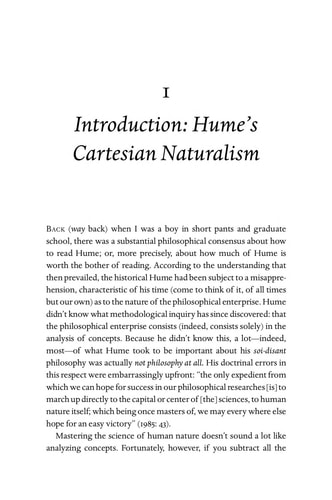
Hume? Yes, David Hume, that's who Jerry Fodor looks to for help in advancing our understanding of the mind. Fodor claims his Treatise of Human Nature as the foundational document of cognitive science: it launched the project of constructing an empirical psychology on the basis of a representational theory of mind. Going back to this work after more than 250 years we find that Hume is remarkably perceptive about the components and structure that a theory of mind requires. Careful study of the Treatise helps us to see what is amiss with much twentieth-century philosophy of mind, and to get on the right track.
Menrva's Summary
THE THESIS
Does David Hume’s A Treatise of Human Nature provide the necessary framework for a modern, empirical science of the mind? Jerry A. Fodor, a prominent philosopher and cognitive scientist, argues that Hume’s eighteenth-century work serves as the foundational text for contemporary cognitive science. By examining Hume’s representational theory of mind, Fodor contends that many modern philosophical approaches have strayed from the essential components required to understand human cognition, suggesting that a return to Humean principles is necessary to correct the trajectory of the field.
THE SCOPE MAP
What You Will Find
- An analysis of David Hume’s A Treatise of Human Nature as a precursor to modern cognitive science.
- A critique of twentieth-century philosophical approaches to the mind.
- An examination of the representational theory of mind and its structural requirements.
- A comparative study between classical empiricism and contemporary psychological models.
THE AUTHORITY PERSPECTIVE
Experts in the philosophy of mind recognize this text as a provocative re-evaluation of historical foundations in relation to modern cognitive theory. Readers frequently note the dense, analytical nature of Fodor’s prose, which assumes a high level of familiarity with both Humean philosophy and contemporary cognitive science debates.
Page Count:
176
Publication Date:
2003-10-02
Publisher:
Oxford University Press
ISBN-10:
0199264058
ISBN-13:
9780199264056
Philosophy
Psychology
Epistemology
Community Tags
Other Editions(3)


Similar Books