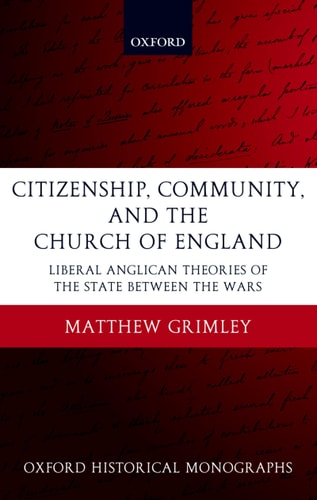
Citizenship, Community, and the Church of England: Liberal Anglicanism Theories of the State between the Wars
0
0
As an Amazon Associate and affiliate partner, Menrva Books earns from qualifying purchases. Learn more
Author Description
This book offers a new evaluation of the political role of the Church of England in inter-war Britain. It argues that, at a time of crises such as the General Strike of 1926, the Prayer Book controversy of 1929, the Abdication Crisis of 1936 and the rise of Hitler, religion remained central to political thought and debate. Anglican thinkers like Archbishop William Temple offered a theory and rhetoric of Christian community which had a wide appeal as an antidote to class consciousness and Nazism, and that Anglicanism played a central role in the articulation of inter-war ideas of Englishness.
Menrva's Summary
THE THESIS
This book investigates how Liberal Anglican thinkers shaped political discourse and the concept of national identity in Britain during the inter-war period. Matthew Grimley, a historian specializing in modern British religious and political thought, utilizes archival records and contemporary theological writings to argue that the Church of England provided a critical framework for navigating social and political crises. By examining the rhetoric of figures like William Temple, the author demonstrates how Christian community theories were deployed to counter class conflict and the rise of totalitarian ideologies.
THE SCOPE MAP
What You Will Find
- Analysis of major inter-war crises including the 1926 General Strike and the 1936 Abdication Crisis.
- Examination of the political influence of the Prayer Book controversy of 1929.
- Evaluation of the role of Anglicanism in defining English national identity.
- Case studies on the intersection of Christian theology and political theory in the face of rising Nazism.
THE AUTHORITY PERSPECTIVE
Scholars recognize this work as a significant contribution to the study of twentieth-century British political thought and the institutional history of the Church of England. Readers frequently note the academic density of the prose and the author's meticulous use of primary source material to support his historical arguments.
Page Count:
272
Publication Date:
2004-08-19
Publisher:
Clarendon Press
ISBN-10:
0199270899
ISBN-13:
9780199270897
History
Religion
British History
Theology
Citizenship
Community Life
Anglicanism
Church of England
Community Tags
Similar Books