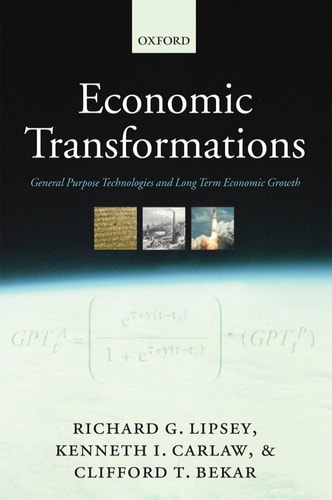
Economic Transformations: General Purpose Technologies and Long-Term Economic Growth
0
0
As an Amazon Associate and affiliate partner, Menrva Books earns from qualifying purchases. Learn more
Author Description
This book examines the long term economic growth that has raised the West's material living standards to levels undreamed of by counterparts in any previous time or place. The authors argue that this growth has been driven by technological revolutions that have periodically transformed the West's economic, social and political landscape over the last 10,000 years and allowed the West to become, until recently, the world's only dominant technological force.Unique in the diversity of the analytical techniques used, the book begins with a discussion of the causes and consequences of economic growth and technological change. The authors argue that long term economic growth is largely driven by pervasive technologies now known as General Purpose (GPTs). They establish an alternative to the standard growth models that use an aggregate production function and then introduce the concept of GPTs, complete with a study of how these technologies have transformed the West since the Neolithic Agricultural Revolution. Early modern science is given more importance than in most other treatments anf the 19th century demographic revolution is studied with a combination of formal models of population dynamics and historical analysis.The authors argue that once sustained growth was established in the West, formal models can shed much light on its subsequent behaviour. They build non-conventional, dynamic, non-stationary equilibrium models of GPT-driven growth that incorporate a range of phenomena that their historical studies show to be important but which are excluded from other GPT models in the interests of analytical tractability. The book concludes with a study of the policy implications that follow from their unique approach.
Menrva's Summary
THE THESIS
This book investigates the role of General Purpose Technologies (GPTs) as the primary drivers of long-term economic growth and societal transformation over the last 10,000 years. The authors, Clifford T. Bekar, Kenneth I. Carlaw, and Richard G. Lipsey, utilize a multidisciplinary framework that combines historical analysis with non-conventional, dynamic equilibrium modeling. By challenging standard aggregate production function models, they argue that technological revolutions are the fundamental mechanism behind the West's rise to material prosperity and global dominance.
THE SCOPE MAP
What You Will Find
- A historical survey of technological revolutions from the Neolithic Agricultural Revolution to the modern era.
- An alternative theoretical framework for economic growth that replaces traditional aggregate production functions.
- Dynamic, non-stationary equilibrium models that incorporate complex socio-political variables.
- An analysis of the policy implications derived from the authors' unique approach to technological change.
THE AUTHORITY PERSPECTIVE
Experts recognize this work as a significant departure from mainstream growth theory, noting its integration of formal modeling with extensive historical data. Readers frequently highlight the academic density of the prose and the authors' rigorous attempt to bridge the gap between historical narrative and mathematical economics.
Page Count:
616
Publication Date:
2006-01-05
Publisher:
Oxford University Press
ISBN-10:
0199285640
ISBN-13:
9780199285648
Economics
Sociology
Technology
Economic History
Community Tags
Similar Books