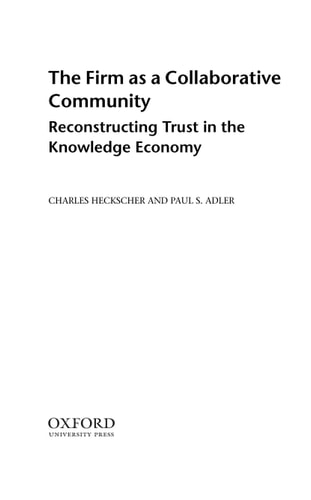
The Firm as a Collaborative Community: The Reconstruction of Trust in the Knowledge Economy
0
0
As an Amazon Associate and affiliate partner, Menrva Books earns from qualifying purchases. Learn more
Author Description
This volume explores the changing nature of community in modern corporations. Community within and between firms--the fabric of trust so essential to contemporary business--has long been based on loyalty. This loyalty has been largely destroyed by three decades of economic turbulence, downsizing and restructuring. Yet community is more important than ever in an increasingly complex, knowledge-intensive economy. The thesis of this volume is that a new form of community is slowly emerging--one that is more flexible and wider in scope than the community of loyalty, and that transcends the limitations of both traditional Gemeinschaft and modern Gesellschaft. We call this form 'collaborative community'.The trend towards collaborative community is difficult to detect amidst the ferocious forces of market and bureaucratic rationalization. But close analysis of some of America's most successful corporations reveals three dimensions of the emerging form:· A shared ethic of interdependent contribution: distinct from the uneasy mix of loyalty and individualism that prevailed for so long;· A formalized set of norms of interdependent process management that include iterative co-design, metaphoric search, and systematic mutual understanding: distinct from both rigid authority hierarchies and informal log-rolling;· An interdependent social identity that supports these organizational features: distinct from both dependent, traditionalistic identities and the independence of the autonomous self that is often associated with Western culture.This volume is a collaborative effort of leading scholars in organization studies to delineate the new form of community and the forces encouraging and constraining it's growth. The contributors combine sociology and psychology theory with detailed analysis of business cases at the firm and inter-firm level.
Menrva's Summary
THE THESIS
This volume investigates how corporations can reconstruct trust and community within the modern knowledge economy following the erosion of traditional loyalty-based structures. The authors, Charles C. Heckscher and Paul S. Adler, assemble a collection of leading scholars in organization studies to examine the shift from rigid hierarchies to a flexible model they term 'collaborative community.' By integrating sociological and psychological theory with empirical business case studies, the text argues that this new organizational form is essential for navigating the complexities of contemporary, knowledge-intensive markets.
THE SCOPE MAP
What You Will Find
- Analysis of the transition from loyalty-based corporate structures to collaborative community models.
- Examination of three core dimensions: shared ethics of contribution, formalized norms of process management, and interdependent social identity.
- Comparative study of organizational dynamics across both firm-level and inter-firm environments.
- Theoretical frameworks blending sociology and psychology to explain modern corporate behavior.
THE AUTHORITY PERSPECTIVE
Experts recognize this work as a significant contribution to organizational theory, particularly for its attempt to formalize the concept of collaborative community in a post-restructuring era. Readers frequently note the academic density of the prose, which serves as a foundational text for scholars and practitioners interested in the evolution of corporate culture.
Page Count:
608
Publication Date:
2006-05-11
Publisher:
Oxford University Press
ISBN-10:
0199286035
ISBN-13:
9780199286034
Business
Economics
Management
Social Aspects
Sociology
Community Tags
Similar Books