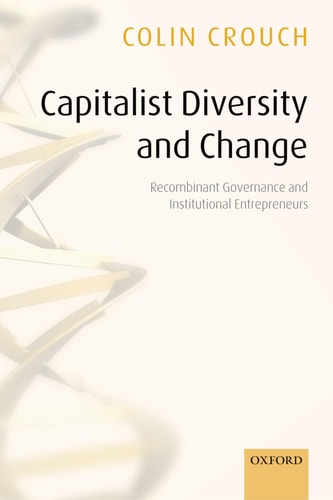
Capitalist Diversity and Change: Recombinant Governance and Institutional Entrepreneurs
0
0
As an Amazon Associate and affiliate partner, Menrva Books earns from qualifying purchases. Learn more
Author Description
Over the last decade the neo-institutionalist literature of comparative capitalism has developed into an influential body of work. In this book, Colin Crouch assesses this literature, and proposes a major re-orientation of the field. Crouch critiques and finds a way of modeling how creative actors trying to achieve change - institutional entrepreneurs - tackle these constraints. Central to the account is the concept of governance, as it is by recombining governance mechanism that these entrepreneurs must achieve their goals. In seeking how to analyze the spaces n which they operate, Crouch criticizes and deconstructs some dominant approaches in socio0political analysis: to typologies, to elective affinity and complementarity, to path dependence. He develops a theory of governance modes, which includes potentially decomposing them into their core components. Finally, he proposes a reorientation of the neo-institutionalist research program to take more account of detailed diversity and potentiality for change. The book is primarily theoretical, but it makes liberal use of examples, particularly from studies of local economic development and politics.
Menrva's Summary
THE THESIS
How can the neo-institutionalist framework of comparative capitalism be reoriented to better account for institutional change and the role of individual agency? Colin Crouch, a prominent scholar in comparative political economy, evaluates existing literature on neo-institutionalism and identifies significant limitations in how it handles change and actor-driven innovation. He argues that current models often over-rely on path dependence and static typologies, failing to capture the dynamic ways in which institutional entrepreneurs navigate and recombine governance mechanisms to achieve specific economic and political outcomes.
THE SCOPE MAP
What You Will Find
- A critical analysis of dominant socio-political theories including path dependence and elective affinity.
- A theoretical framework for decomposing governance modes into their core components.
- Case studies focusing on local economic development and regional political structures.
- A proposed research agenda for future studies in comparative capitalism that prioritizes diversity and potentiality.
THE AUTHORITY PERSPECTIVE
Experts recognize this work as a significant intervention in the field of comparative political economy, particularly for its attempt to bridge the gap between structural constraints and individual agency. Readers frequently note the academic density of the prose, which is intended for advanced students and researchers in sociology and political science.
Page Count:
192
Publication Date:
2005-12-08
Publisher:
Oxford University Press
ISBN-10:
0199286655
ISBN-13:
9780199286652
Economics
Sociology
Governance
Community Tags
Similar Books