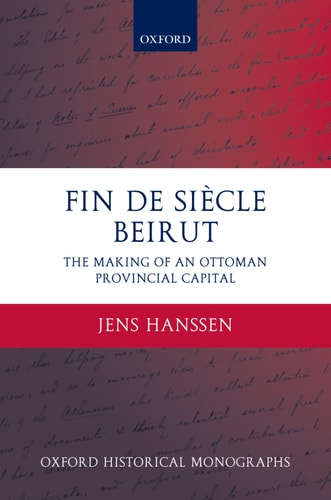
Fin de Siècle Beirut: The Making of an Ottoman Provincial Capital
0
0
As an Amazon Associate and affiliate partner, Menrva Books earns from qualifying purchases. Learn more
Author Description
Postwar Beirut conjures up contradictory images of remarkable openness and inconceivable violence, of great antiquity and a bright future. The Lebanese capital stands for Arab cosmopolitanism and cultural effervescence but also for its tragedies of destruction. This book examines the historical formation of Beirut as a multiply contested Mediterranean city.Fin de Siècle Beirut is a landmark contribution to the growing literature in Ottoman studies, in Arab cultural history and on Mediterranean cities. Combining urban theory, particularly Henri Lefebvre's work on cities and capitalism, with postcolonial methodology, the central thesis of this book is that modern Beirut is the outcome of persistent social and intellectual struggles over the production of space. The city of Beirut was at once the product, the object, and the project of imperial and urban politics of difference: overlapping European, Ottoman, and municipal civilising missions competed in the political fields of administration, infrastructure, urban planning, public health, education, public morality, journalism, and architecture.Jens Hanssen offers a comprehensive, original account of the emergence of modern Beirut out of an economic shift away from Acre in the wake of the Napoleonic wars. He argues that the Ottoman government's decision to heed calls for the creation of a new province around Beirut and grant it provincial capital status in 1888 paved the way for fundamental urban and regional reconfigurations long before colonial policies during the French Mandate period. This new Ottoman province came to constitute the territorial embodiment of regional self-determination for Arab nationalists in Beirut until the dissolution of the Ottoman Empire after World War I.Drawing on published and unpublished Ottoman government documents, Arabic sources, and European archival material, Hanssen's book traces the urban experience of modernity in the Ottoman Empire. The transformation of everyday life in late nineteenth-century Beirut and the concomitant policies of urban management is vividly set against the devastating civil war in Mount Lebanon and Damascus in 1860.
Menrva's Summary
THE THESIS
This book investigates how the late nineteenth-century transformation of Beirut into an Ottoman provincial capital established the foundations for its modern urban identity and regional political significance. Jens Hanssen, a scholar of Middle Eastern history, utilizes a framework that synthesizes Henri Lefebvre’s urban theory with postcolonial methodology to analyze the city's development. By examining the interplay between imperial administration, municipal planning, and local intellectual movements, the author argues that Beirut’s modern character emerged from persistent social and political struggles over the production of space long before the French Mandate.
THE SCOPE MAP
What You Will Find
- Analysis of the economic shift from Acre to Beirut following the Napoleonic Wars.
- Examination of the 1888 administrative reforms that granted Beirut provincial capital status.
- Investigation into the competition between European, Ottoman, and municipal civilizing missions.
- Use of primary source materials including Ottoman government documents, Arabic texts, and European archival records.
THE AUTHORITY PERSPECTIVE
Scholars in the field of Ottoman studies and urban history regard this work as a foundational text for understanding the intersection of imperial policy and local development in the Mediterranean. Readers frequently note the academic density of the prose and the author's rigorous application of urban theory to historical archival data.
Page Count:
340
Publication Date:
2005-09-29
Publisher:
Clarendon Press
ISBN-10:
0199281637
ISBN-13:
9780199281633
History
Ottoman Empire
Lebanon history
Sociology
Urban Studies
Community Tags
Similar Books









Reader Comments
Share Your Thoughts
No comments yet. Be the first to share your thoughts!