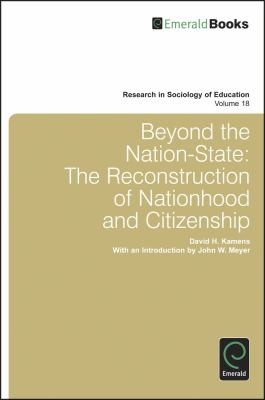
Beyond the NationState
0
0
As an Amazon Associate and affiliate partner, Menrva Books earns from qualifying purchases. Learn more
Author Description
The book examines the effects of education in creating global citizens who share a world culture. This occurs within an international system that still remains decentralized, composed of independent nation-states as major actors. Prof. Kamens argues that as globalization intensifies, this system of nation-states becomes more saturated and dense with structure. Intensified globalization has produced a world society, thanks to the spread of global capitalism, education, democracy and bureaucracy. The upshot is that world culture travels quickly and produces recipes for the development of an imagined community that has increasing commonalities across societies. The book examines the role of education in diffusing such attitudes and models, as global citizens confront national institutions.
Menrva's Summary
THE THESIS
This book investigates how educational systems contribute to the formation of global citizens within a world culture, despite the continued existence of a decentralized international system dominated by nation-states. John W. Meyer, a distinguished scholar in the sociology of education, draws upon extensive research to argue that intensified globalization has led to a more structured and saturated system of nation-states. This process has fostered a world society characterized by the rapid diffusion of global capitalism, education, democracy, and bureaucracy, creating commonalities across societies and promoting an imagined global community. The book specifically examines education's role in disseminating these attitudes and models as global citizens increasingly interact with national institutions.
THE SCOPE MAP
- The impact of education on creating global citizens and a shared world culture.
- Analysis of the international system's structure, focusing on the role of nation-states.
- The effects of intensified globalization on the saturation and density of the nation-state system.
- The emergence of world society through the spread of global capitalism, education, democracy, and bureaucracy.
- The mechanisms by which world culture and commonalities across societies are diffused.
- The role of education in diffusing attitudes and models for global citizenship.
- The interaction between global citizens and national institutions in the contemporary world.
THE AUTHORITY PERSPECTIVE
This work is recognized for its in-depth analysis of the complex interplay between education, globalization, and the persistence of nation-states. It offers a sociological perspective on how global culture is disseminated and adopted, particularly through educational frameworks. The book is likely to be of interest to scholars and students in sociology, international relations, and education policy who are examining the evolving landscape of global citizenship and governance.
Page Count:
300
Publication Date:
2012-01-01
ISBN-10:
178052708X
ISBN-13:
9781780527086
Non-Fiction
Philosophy
Politics
Economics
Science
Sociology
Globalization
Education
Community Tags
Similar Books