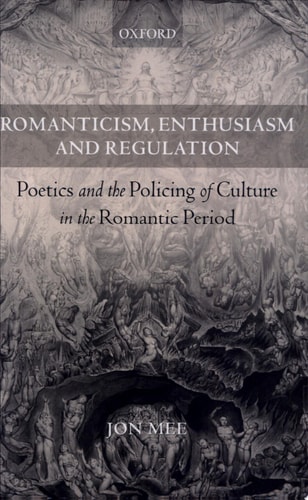
Romanticism, Enthusiasm, and Regulation: Poetics and the Policing of Culture in the Romantic Period
0
0
As an Amazon Associate and affiliate partner, Menrva Books earns from qualifying purchases. Learn more
Author Description
What is enthusiasm? Enthusiasm for most of the eighteenth century was identified with excess of religious feeling, although it came increasingly to be used to describe the unregulated and infectious urgings of the crowd more generally. Yet there was a developing alternative understanding of the term which identified it with a therapeutic influx of feeling in an increasingly formalistic and commodified world. This understanding came to be particularly identified with poetry. Enthusiasm was deemed a necessary condition of poetry by the end of the century, but not a sufficient one. For without proper regulation, poetic enthusiasm might become nothing more than the formless emotionalism of the crowd that the literary elite perceived all around them. Although enthusiasm might be thought of as a distinctly Romantic term, this study looks at the way the inherited discourse of enthusiasm structured most writing of the Romantic period. Many of those new to writing as a career in the period took enthusiasm to license their feelings as a legitimate basis for turning to print. Others took this as an alarming version of the old virus. Few elite writers, Coleridge and Wordsworth included, did not take pains to show they were on the right side of the fence that separate the noble enthusiasm of the poet from either the fanaticism of the crowd or the undisciplined pretensions of hacks and scribblers. Understanding the influence of these processes of regulation and the difficulty faced by writers in clearly articulating the difference they were meant to enshrine is at the center of Romanticism, Enthusiasm, and Regulation.
Menrva's Summary
THE THESIS
This study investigates how the eighteenth-century discourse of 'enthusiasm' functioned as a mechanism for regulating cultural production and defining the boundaries of legitimate authorship during the Romantic period. Jon Mee, a scholar of Romantic-era literature and culture, examines the tension between the perceived necessity of enthusiasm in poetry and the fear of its association with unregulated, fanatical crowds. By analyzing the works of canonical figures like Wordsworth and Coleridge alongside the broader literary marketplace, the author argues that the period's writing was deeply structured by the need to distinguish 'noble' poetic inspiration from the perceived emotional excess of the masses.
THE SCOPE MAP
What You Will Find
- An analysis of the shifting definitions of enthusiasm from religious excess to a therapeutic poetic quality.
- A historical examination of the professionalization of writing and the rise of the literary career.
- Case studies of elite writers attempting to distance their work from the 'undisciplined' output of contemporary hacks and scribblers.
- A framework for understanding how cultural regulation shaped the poetics of the late eighteenth and early nineteenth centuries.
THE AUTHORITY PERSPECTIVE
Scholars frequently cite this work as a significant contribution to the understanding of the social and political pressures influencing Romantic-era aesthetics. Readers often note the academic density of the prose, which provides a rigorous examination of the period's complex intellectual history.
Page Count:
336
Publication Date:
2005-09-01
Publisher:
Oxford University Press
ISBN-10:
0199284784
ISBN-13:
9780199284788
History
Poetry
Romanticism
Enthusiasm
Literary Criticism
Community Tags
Similar Books