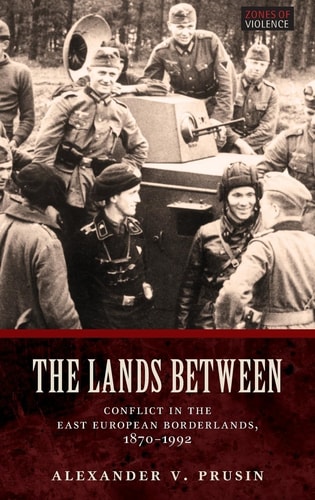
The Lands Between: Conflict in the East European Borderlands, 1870-1992
0
0
As an Amazon Associate and affiliate partner, Menrva Books earns from qualifying purchases. Learn more
Author Description
The Lands Between investigates the causes and dynamics of conflict in the "borderlands" of Eastern Europe: the modern Baltic republics of Estonia, Latvia, and Lithuania, the western provinces of Byelorussia and Ukraine, and the republic of Moldova -- areas that have changed hands in the course of the twentieth-century on several occasions. Alexander V. Prusin looks at these "borderlands" as a whole, synthesizing narrower national histories into a wider-ranging study that highlights the common factors feeding conflict across the region. He also takes a long-term view, from the modernizing of the Russian and Austro-Hungarian empires in the late nineteenth century, through to the break-up of the Soviet Union, with a particular focus on the 'era of conflict' between the outbreak of the First World War and the Soviet pacification of the area in the mid-1950s.While admitting the importance of socio-economic cleavages and ethnic rivalries in creating conflict, Prusin argues that the borderlands' ethno-cultural diversity was in basic conflict with the policies of the authorities that dominated the region, whether these authorities were imperial or (after 1919) nation states. Since collective identities in the borderlands were based on ethno-communal rather than national association, connections between ethnic groups across state borders raised suspicions that their allegiances and identities were not necessarily compatible with those envisioned by the ruling authority. In wartime, when the state's economic and human resources became strained to the limit, suspicion of the groups deemed less loyal blurred the concept of internal and external enemies and entailed pressure on allegedly "corrosive" ethnic elements.Efforts to impose some sort of supranational identity upon the patchwork of ethnically-mixed settlements thus became the standard practice through the first half of the twentieth-century, accelerating the conflict between the state and the population and making the potential for extreme violence so much greater. Simultaneously, as war progressed, violence was sustained and exacerbated by popular participation and acquired its own destructive logic, mutating into a vicious cycle of ethnic conflicts and civil wars.
Menrva's Summary
THE THESIS
This work investigates the underlying causes and recurring dynamics of ethnic and state-driven conflict within the Eastern European borderlands from the late nineteenth century through the collapse of the Soviet Union. Alexander V. Prusin, a historian specializing in the region, synthesizes national histories into a unified framework to examine how ethno-cultural diversity frequently clashed with the homogenizing policies of imperial and nation-state authorities. By analyzing the period between 1870 and 1992, the author argues that the state's suspicion of cross-border ethnic allegiances often led to the systematic targeting of minority groups during times of national crisis.
THE SCOPE MAP
What You Will Find
- A comprehensive historical analysis of the Baltic republics, western Byelorussia, Ukraine, and Moldova.
- An examination of the 'era of conflict' spanning from the First World War through the mid-1950s Soviet pacification.
- A theoretical framework linking state-building efforts to the suppression of ethno-communal identities.
- Evidence derived from the comparative study of imperial and post-1919 nation-state administrative policies.
THE AUTHORITY PERSPECTIVE
Scholars and historians recognize this text as a significant contribution to the study of regional ethnic violence and state formation. Readers frequently note the academic density of the prose and the author's ability to synthesize complex geopolitical shifts into a coherent, long-term historical argument.
Page Count:
324
Publication Date:
2010-09-30
Publisher:
Oxford University Press
ISBN-10:
0199297533
ISBN-13:
9780199297535
History
European History
Military History
Eastern Europe
Sociology
Community Tags
Similar Books
Reader Comments
Share Your Thoughts
No comments yet. Be the first to share your thoughts!