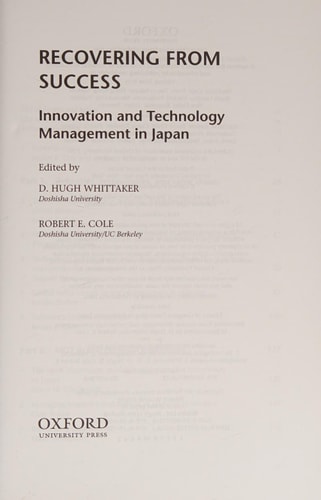
Recovering from Success: Innovation and Technology Management in Japan
0
0
As an Amazon Associate and affiliate partner, Menrva Books earns from qualifying purchases. Learn more
Author Description
How did Japan fall from challenger to US hegemonic leadership in the high tech industries in the 1980s, to stumbling giant by the turn of the century? This book examines the challenges faced by Japanese companies through emulation by foreign competitors, and the emergence of new competitive models linked to open innovation and modular production.
Menrva's Summary
THE THESIS
This book investigates the structural and strategic factors that led to the decline of Japan's dominance in high-technology industries between the 1980s and the early 21st century. Authors D. Hugh Whittaker and Robert E. Cole utilize their extensive expertise in Japanese industrial organization to analyze how the country's once-successful business models struggled to adapt to the rise of open innovation and modular production. By examining the transition from a challenger to a stagnant economic force, the authors provide a framework for understanding the limitations of traditional Japanese management practices in a globalized, rapidly shifting technological landscape.
THE SCOPE MAP
What You Will Find
- Analysis of the shift from integrated manufacturing to modular production systems.
- Examination of the impact of foreign competition and the emulation of Japanese industrial practices.
- Case studies focusing on the electronics and high-tech sectors in Japan.
- Evaluation of the challenges posed by open innovation models to established corporate hierarchies.
THE AUTHORITY PERSPECTIVE
Experts recognize this work as a rigorous examination of the institutional rigidities that hindered Japanese corporate adaptation. Readers frequently note the academic density of the prose, which provides a detailed, evidence-based account of the complexities inherent in managing technological change.
Page Count:
352
Publication Date:
2006-10-12
Publisher:
Oxford University Press
ISBN-10:
0199297312
ISBN-13:
9780199297313
Business
Economics
Innovation
Industrial history
Japan
Technology management
Community Tags
Similar Books