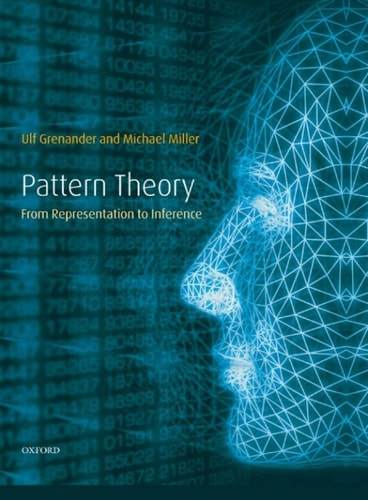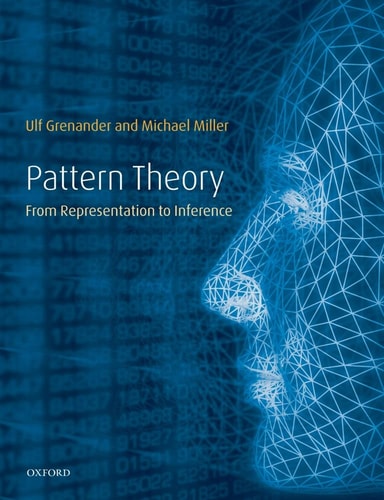
Pattern Theory: From Representation to Inference
0
0
As an Amazon Associate and affiliate partner, Menrva Books earns from qualifying purchases. Learn more
Author Description
Pattern Theory provides a comprehensive and accessible overview of the modern challenges in signal, data, and pattern analysis in speech recognition, computational linguistics, image analysis and computer vision. Aimed at graduate students in biomedical engineering, mathematics, computer science, and electrical engineering with a good background in mathematics and probability, the text include numerous exercises and an extensive bibliography. Additional resources including extended proofs, selected solutions and examples are available on a companion website.The book commences with a short overview of pattern theory and the basics of statistics and estimation theory. Chapters 3-6 discuss the role of representation of patterns via condition structure. Chapters 7 and 8 examine the second central component of pattern theory: groups of geometric transformation applied to the representation of geometric objects. Chapter 9 moves into probabilistic structures in the continuum, studying random processes and random fields indexed over subsets of Rn. Chapters 10 and 11 continue with transformations and patterns indexed over the continuum. Chapters 12-14 extend from the pure representations of shapes to the Bayes estimation of shapes and their parametric representation. Chapters 15 and 16 study the estimation of infinite dimensional shape in the newly emergent field of Computational Anatomy. Finally, Chapters 17 and 18 look at inference, exploring random sampling approaches for estimation of model order and parametric representing of shapes.
Menrva's Summary
THE THESIS
This text investigates the mathematical foundations and computational frameworks required to represent and infer complex patterns within signal, image, and linguistic data. Authors Michael I. Miller and Ulf Grenander leverage their expertise in biomedical engineering and mathematics to synthesize a rigorous approach to pattern theory. The book establishes a structured methodology for moving from raw data representation to sophisticated Bayesian estimation, providing a cohesive framework for graduate-level research in computational fields.
THE SCOPE MAP
What You Will Find
- Mathematical foundations of statistics and estimation theory applied to pattern analysis.
- Geometric transformation groups and their role in representing complex objects.
- Probabilistic structures, including random processes and random fields indexed over subsets of Rn.
- Advanced applications in Computational Anatomy and Bayesian shape estimation.
THE AUTHORITY PERSPECTIVE
Experts recognize this work as a foundational text for graduate students in engineering and mathematics seeking a formal introduction to pattern theory. Readers frequently note the high level of mathematical density, which necessitates a strong background in probability and calculus to fully grasp the presented proofs and methodologies.
Page Count:
608
Publication Date:
2007-02-08
Publisher:
Oxford University Press
ISBN-10:
0199297061
ISBN-13:
9780199297061
Statistics
Data Analysis
Mathematics
Computer Science
Engineering