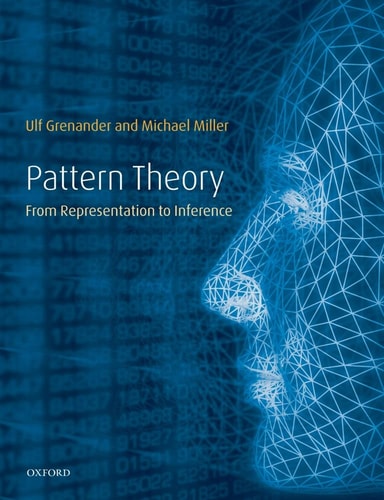
Pattern Theory: From Representation to Inference
0
0
As an Amazon Associate and affiliate partner, Menrva Books earns from qualifying purchases. Learn more
Author Description
Pattern Theory: From Representation to Inference provides a comprehensive and accessible overview of the modern challenges in signal, data and pattern analysis in speech recognition, computational linguistics, image analysis and computer vision. Aimed at graduate students in biomedical engineering, mathematics, computer science and electrical engineering with a good background in mathematics and probability, the text includes numerous exercises and an extensive bibliography. Additional resources including extended proofs, selected solutions and examples are available on a companion website. The book commences with a short overview of pattern theory and the basics of statistics and estimation theory. Chapters 3-6 discuss the role of representation of patterns via conditioning structure and Chapters 7 and 8 examine the second central component of pattern theory: groups of geometric transformation applied to the representation of geometric objects. Chapter 9 moves into probabilistic structures in the continuum, studying random processes and random fields indexed over subsets of Rn, and Chapters 10, 11 continue with transformations and patterns indexed over the continuum. Chapters 12-14 extend from the pure representations of shapes to the Bayes estimation of shapes and their parametric representation. Chapters 15 and 16 study the estimation of infinite dimensional shape in the newly emergent field of Computational Anatomy, and finally Chapters 17 and 18 look at inference, exploring random sampling approaches for estimation of model order and parametric representing of shapes.
Menrva's Summary
THE THESIS
This text investigates the mathematical foundations of pattern theory, specifically addressing how complex data structures can be represented and inferred across various scientific domains. Authors Michael I. Miller and Ulf Grenander utilize their expertise in biomedical engineering and mathematics to construct a rigorous framework for signal and image analysis, bridging the gap between abstract representation and practical statistical estimation.
THE SCOPE MAP
What You Will Find
- Mathematical frameworks for pattern representation and conditioning structures
- Analysis of geometric transformation groups applied to objects
- Probabilistic structures in the continuum, including random processes and fields
- Bayesian estimation methodologies for shapes and parametric models
- Applications in computational anatomy and model order inference
Scope Limits
- The text assumes a strong prior background in advanced mathematics and probability theory
- It does not provide introductory material for readers lacking foundational knowledge in statistics or engineering
THE AUTHORITY PERSPECTIVE
Experts identify this work as a foundational text for graduate-level study in computational linguistics and computer vision. Readers frequently note the high level of academic density, requiring significant mathematical proficiency to navigate the proofs and exercises effectively.
Page Count:
608
Publication Date:
2006-01-01
Publisher:
OUP Oxford
ISBN-10:
0191523119
ISBN-13:
9780191523113
Technology & Engineering
Computer Science
Trades & Technology
Statistics
Mathematics
Data Analysis