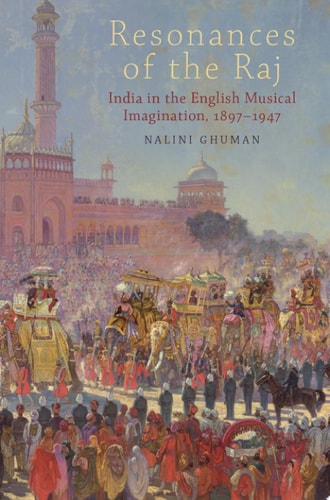
Resonances of the Raj: India in the English Musical Imagination, 1897-1947
0
0
As an Amazon Associate and affiliate partner, Menrva Books earns from qualifying purchases. Learn more
Author Description
During the century of British rule of the Indian subcontinent known as the British Raj, the rulers felt the significant influence of their exotic subjects. Resonances of the Raj examines the ramifications of the intertwined and overlapping histories of Britain and India on English music in the last fifty years of the colonial encounter, and traces the effects of the Raj on the English musical imagination. Conventional narratives depict a one-way influence of Britain on India, with the 'discovery' of Indian classical music occurring only in the post-colonial era. Drawing on new archival sources and approaches in cultural studies, author Nalini Ghuman shows that on the contrary, England was both deeply aware of and heavily influenced by India musically during the Indian-British colonial encounter.Case studies of representative figures, including composers Edward Elgar and Gustav Holst, and Maud MacCarthy, an ethnomusicologist and performer of the era, integrate music directly into the cultural history of the British Raj. Ghuman thus reveals unexpected minglings of peoples, musics and ideas that raise questions about 'Englishness', the nature of Empire, and the fixedness of identity. Richly illustrated with analytical music examples and archival photographs and documents, many of which appear here in print for the first time, Resonances of the Raj brings fresh hearings to both familiar and little-known musics of the time, and reveals a rich and complex history of cross-cultural musical imaginings which leads to a reappraisal of the accepted historiographies of both British musical culture and of Indo-Western fusion.
Menrva's Summary
THE THESIS
This book investigates the reciprocal musical influence between India and Britain during the final fifty years of the British Raj, challenging the assumption that Indian influence on English music began only in the post-colonial era. Author Nalini Ghuman, a scholar of musicology and cultural history, utilizes previously untapped archival materials and cultural studies frameworks to argue that English composers were deeply engaged with Indian musical traditions long before the mid-twentieth century. By examining the works of figures such as Edward Elgar and Gustav Holst, the text demonstrates how the colonial encounter fundamentally shaped the English musical imagination and redefined concepts of national identity.
THE SCOPE MAP
What You Will Find
- Analysis of the musical output of Edward Elgar, Gustav Holst, and Maud MacCarthy.
- Examination of the intersection between colonial history and musicology from 1897 to 1947.
- Integration of primary source archival photographs, documents, and analytical musical scores.
- A critical reappraisal of Indo-Western fusion historiography and the construction of Englishness.
THE AUTHORITY PERSPECTIVE
Experts recognize this work as a significant contribution to the study of colonial musicology, noting its success in bridging the gap between historical analysis and musical theory. Scholars frequently highlight the text's rigorous use of archival evidence to dismantle long-standing misconceptions regarding the timeline of cross-cultural musical exchange.
Page Count:
368
Publication Date:
2014-06-12
Publisher:
Oxford University Press
ISBN-10:
0199314896
ISBN-13:
9780199314898
Music
History
Music Indic
British History
Humanities
Colonialism
Musicology
Criticism history
Music History
Music British
Community Tags
Similar Books