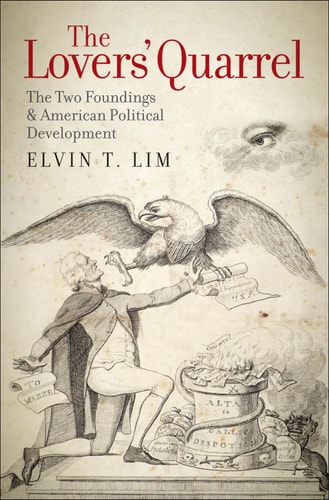
The Lovers' Quarrel: The Two Foundings and American Political Development
0
0
As an Amazon Associate and affiliate partner, Menrva Books earns from qualifying purchases. Learn more
Author Description
The United States has had not one, but two Foundings. The Constitution produced by the Second Founding came to be only after a vociferous battle between Federalists and Anti-Federalists. The Federalists favored a relatively powerful central government, while the Anti-Federalists distrusted the concentration of power in one place and advocated the preservation of sovereignty in the states as crucibles of post-revolutionary republicanism -- the legacy of the First Founding. This philosophical cleavage has been at the heart of practically every major political conflict in U.S. history, and lives on today in debates between modern liberals and conservatives. In The Lovers' Quarrel, Elvin T. Lim presents a systematic and innovative analysis of this perennial struggle. The framers of the second Constitution, the Federalists, were not operating in an ideational or institutional vacuum; rather, the document they drafted and ratified was designed to remedy the perceived flaws of the Articles of Confederation and Perpetual Union. To decouple the Two Foundings is to appreciate that there is no such thing as "original meaning," only original dissent. Because the Anti-Federalists insisted that prior and democratically sanctioned understandings of federalism and union had to be negotiated and partially grafted onto the new Constitution, the Constitution's Articles and the Bill of Rights do not cohere as well together as has conventionally been thought. Rather, they represent two antithetical orientations toward power, liberty, and republicanism. The altercation over the necessity of the Second Founding generated coherent and self-contained philosophies that would become the core of American political thought, reproduced and transmitted across two centuries, whether the victors were the neo-Federalists (such as during the Civil War and the New Deal) or the neo-Anti-Federalists (such as during the Jacksonian era and the Reagan Revolution).
Menrva's Summary
THE THESIS
This book investigates the core question of whether the American political system is defined by a singular founding or a persistent, unresolved conflict between two competing visions of governance. Elvin T. Lim, a scholar of American political development, argues that the tension between the First Founding—represented by the Articles of Confederation—and the Second Founding—the U.S. Constitution—created a permanent philosophical cleavage. By analyzing the historical debate between Federalists and Anti-Federalists, Lim posits that American political history is not a linear progression but a recurring cycle of dissent that continues to shape modern liberal and conservative ideologies.
THE SCOPE MAP
What You Will Find
- A comparative analysis of the Articles of Confederation and the U.S. Constitution.
- A framework for understanding American political history as a series of oscillations between neo-Federalist and neo-Anti-Federalist eras.
- Historical case studies ranging from the Civil War and the New Deal to the Jacksonian era and the Reagan Revolution.
- An examination of the Bill of Rights as a negotiated compromise rather than a coherent extension of the original constitutional design.
THE AUTHORITY PERSPECTIVE
Experts in political science and constitutional history recognize this work as a significant contribution to the study of American political development. Readers frequently note the academic density of the prose and the author's rigorous approach to reconciling historical dissent with contemporary political polarization.
Page Count:
307
Publication Date:
2013-01-01
Publisher:
Oxford University Press
ISBN-10:
019932395X
ISBN-13:
9780199323951
History
United States
Political Philosophy
American History
Special Topics
Government
Community Tags
Similar Books