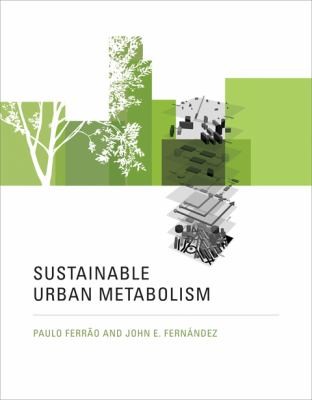
Sustainable Urban Metabolism
0
0
As an Amazon Associate and affiliate partner, Menrva Books earns from qualifying purchases. Learn more
Author Description
Urbanization and globalization have shaped the last hundred years. These two dominant trends are mutually reinforcing: globalization links countries through the networked communications of urban hubs. The urban population now generates more than eighty percent of global GDP. Cities account for enormous flows of energy and materials--inflows of goods and services and outflows of waste. Thus urban environmental management critically affects global sustainability. In this book, Paulo Ferrão and John Fernández offer a metabolic perspective on urban sustainability, viewing the city as a metabolism, in terms of its exchanges of matter and energy. Their book provides a roadmap to the strategies and tools needed for a scientifically based framework for analyzing and promoting the sustainability of urban systems. Using the concept of urban metabolism as a unifying framework, Ferrão and Fernandez describe a systems-oriented approach that establishes useful linkages among environmental, economic, social, and technical infrastructure issues. These linkages lead to an integrated information-intensive platform that enables ecologically informed urban planning. After establishing the theoretical background and describing the diversity of contributing disciplines, the authors sample sustainability approaches and tools, offer an extended study of the urban metabolism of Lisbon, and outline the challenges and opportunities in approaching urban sustainability in both developed and developing countries--Dust jacket.
Menrva's Summary
THE THESIS
This book investigates how cities function as metabolic systems and proposes a framework for achieving urban sustainability. The authors, Paulo Ferrão and John Fernández, present a systems-oriented approach that views cities through the lens of matter and energy exchange. They argue that understanding urban metabolism is critical for effective environmental management and global sustainability, offering strategies and tools for analysis and planning. The book integrates environmental, economic, social, and technical infrastructure issues to create an information-intensive platform for ecologically informed urban planning.
THE SCOPE MAP
- A metabolic perspective on urban sustainability, viewing cities as systems of matter and energy exchange.
- Strategies and tools for scientifically analyzing and promoting the sustainability of urban systems.
- A systems-oriented approach linking environmental, economic, social, and technical infrastructure.
- An integrated information-intensive platform for ecologically informed urban planning.
- Theoretical background and the diversity of contributing disciplines to urban metabolism.
- An extended study of the urban metabolism of Lisbon.
- An outline of challenges and opportunities in urban sustainability for developed and developing countries.
THE AUTHORITY PERSPECTIVE
The book offers a comprehensive framework for understanding urban sustainability through the concept of urban metabolism. It is structured to provide both theoretical background and practical tools for analysis and planning. The authors' approach integrates various disciplines to address the complex challenges of managing urban resource flows. The work is positioned as a roadmap for developing ecologically informed urban planning strategies.
Page Count:
244
Publication Date:
2013-01-01
ISBN-10:
0262019361
ISBN-13:
9780262019361
Science
Non-Fiction
urban planning
Systems Thinking
Urban Studies
Sustainability
Community Tags
Similar Books