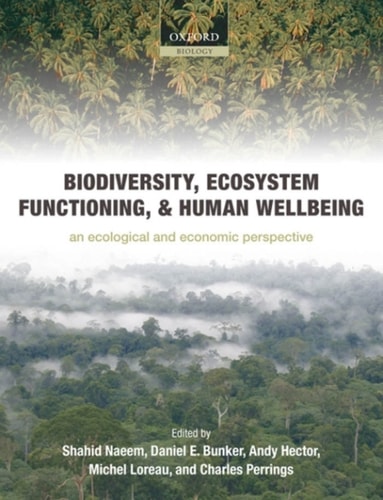
Biodiversity, Ecosystem Functioning, and Human Wellbeing: An Ecological and Economic Perspective
0
0
As an Amazon Associate and affiliate partner, Menrva Books earns from qualifying purchases. Learn more
Author Description
How will biodiversity loss affect ecosystem functioning, ecosystem services, and human well-being? In an age of accelerating biodiversity loss, this timely and critical volume summarizes recent advances in biodiversity-ecosystem functioning research and explores the economics of biodiversity and ecosystem services. The book starts by summarizing the development of the basic science and provides a meta-analysis that quantitatively tests several biodiversity and ecosystem functioning hypotheses. It then describes the natural science foundations of biodiversity and ecosystem functioning research including: quantifying functional diversity, the development of the field into a predictive science, the effects of stability and complexity, methods to quantify mechanisms by which diversity affects functioning, the importance of trophic structure, microbial ecology, and spatial dynamics. Finally, the book takes research on biodiversity and ecosystem functioning further than it has ever gone into the human dimension, describing the most pressing environmental challenges that face humanity and the effects of diversity on: climate change mitigation, restoration of degraded habitats, managed ecosystems, pollination, disease, and biological invasions. However, what makes this volume truly unique are the chapters that consider the economic perspective. These include a synthesis of the economics of ecosystem services and biodiversity, and the options open to policy-makers to address the failure of markets to account for the loss of ecosystem services; an examination of the challenges of valuing ecosystem services and, hence, to understanding the human consequences of decisions that neglect these services; and an examination of the ways in which economists are currently incorporating biodiversity and ecosystem functioning research into decision models for the conservation and management of biodiversity. A final section describes new advances in ecoinformatics that will help transform
Menrva's Summary
THE THESIS
This volume investigates the complex relationship between biodiversity loss, ecosystem functionality, and the resulting economic consequences for human wellbeing. The authors, led by experts in ecological research, synthesize recent scientific advances to test hypotheses regarding how species diversity influences ecosystem stability and services. By bridging the gap between natural science and economic modeling, the text provides a framework for understanding how environmental degradation impacts human society and how policy-makers might address these market failures.
THE SCOPE MAP
What You Will Find
- Meta-analysis of biodiversity and ecosystem functioning hypotheses
- Quantitative methods for measuring functional diversity and trophic structure
- Economic models for valuing ecosystem services and addressing market failures
- Analysis of environmental challenges including climate change, pollination, and biological invasions
- Integration of ecoinformatics in conservation decision-making
Scope Limits
- The text focuses primarily on the intersection of ecology and economics rather than providing a comprehensive guide to individual species conservation.
- It does not offer exhaustive policy solutions for every specific regional environmental crisis.
THE AUTHORITY PERSPECTIVE
Experts recognize this volume as a significant interdisciplinary resource that successfully bridges the divide between ecological theory and economic application. Readers frequently note the academic density of the prose, which makes it a valuable reference for researchers and policy-makers engaged in environmental management.
Page Count:
384
Publication Date:
2009-01-01
Publisher:
OUP Oxford
ISBN-10:
0191563323
ISBN-13:
9780191563324
Science
English
Evolution
Linguistics
Nature
English & College Success
Biodiversity
Ecology
Sustainability
Community Tags
Similar Books




Reader Comments
Share Your Thoughts
No comments yet. Be the first to share your thoughts!