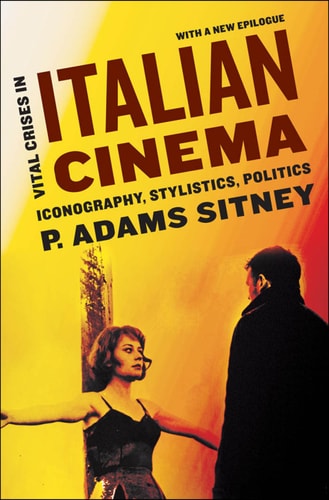
Vital Crises in Italian Cinema: Iconography, Stylistics, Politics
0
0
As an Amazon Associate and affiliate partner, Menrva Books earns from qualifying purchases. Learn more
Author Description
Examining the landmark works that ushered in Italy's golden age of cinema, P. Adams Sitney provides a stylish, historically rich survey of the epochal films made by Roberto Rossellini, Vittorio De Sica, Luchino Visconti, Federico Fellini, Michelangelo Antonioni, and others in the years after World War II. Remarking on the period in 1957, Pier Paolo Pasolini wrote that its films reflected a "vital crisis" in Italian culture after the fall of Fascism. Sitney expands this conceit to demonstrate the multivalent social and political forces behind a range of movies made from the mid-1940s through the1960s that includes Paisa, La terra trema, Ladri di biciclette, L'Avventura, and La dolce vita. Throughout its pages, the book considers how the nation's cinema depicts the convergence of Christian and Resistance iconography; contemplates the debate over dialect and a national language; deploys cinematic effects for the purposes of political allegory; and incorporates insights from the psychoanalytic discourse that became popular in Italy during the fifties and sixties. This new edition includes an epilogue that extends the range of the study into the 1970s with discussions of Nanni Moretti's Io sono autaurchico, the Tavianis' Padre Padrone, and Ermanno Olmi's L'albero degli zoccoli.
Menrva's Summary
THE THESIS
This book investigates how the post-World War II Italian cinema reflected a profound cultural and political crisis following the collapse of Fascism. P. Adams Sitney, a noted scholar of avant-garde and international cinema, utilizes a rigorous analytical framework to examine how filmmakers navigated the transition from wartime trauma to the complexities of the mid-century social landscape. By synthesizing historical context with formal film analysis, the author argues that these cinematic works functioned as both aesthetic achievements and critical allegories for a nation in flux.
THE SCOPE MAP
What You Will Find
- Analysis of major works by directors including Rossellini, De Sica, Visconti, Fellini, and Antonioni.
- Examination of the intersection between Christian iconography and the Italian Resistance movement.
- Discussion of the linguistic debates regarding dialect versus a standardized national language in film.
- Application of psychoanalytic discourse to interpret the thematic shifts in Italian cinema during the 1950s and 1960s.
THE AUTHORITY PERSPECTIVE
Experts recognize this work as a foundational text for understanding the formal and political evolution of Italian neorealism and its successors. Readers frequently note the academic density of the prose, which provides a sophisticated lens for students and scholars of film history.
Page Count:
288
Publication Date:
2013-01-01
Publisher:
Oxford University Press
ISBN-10:
0199324107
ISBN-13:
9780199324101
History
Cinema History
European History
Italian History
Film Studies
Film Criticism
Motion pictures
Community Tags
Similar Books